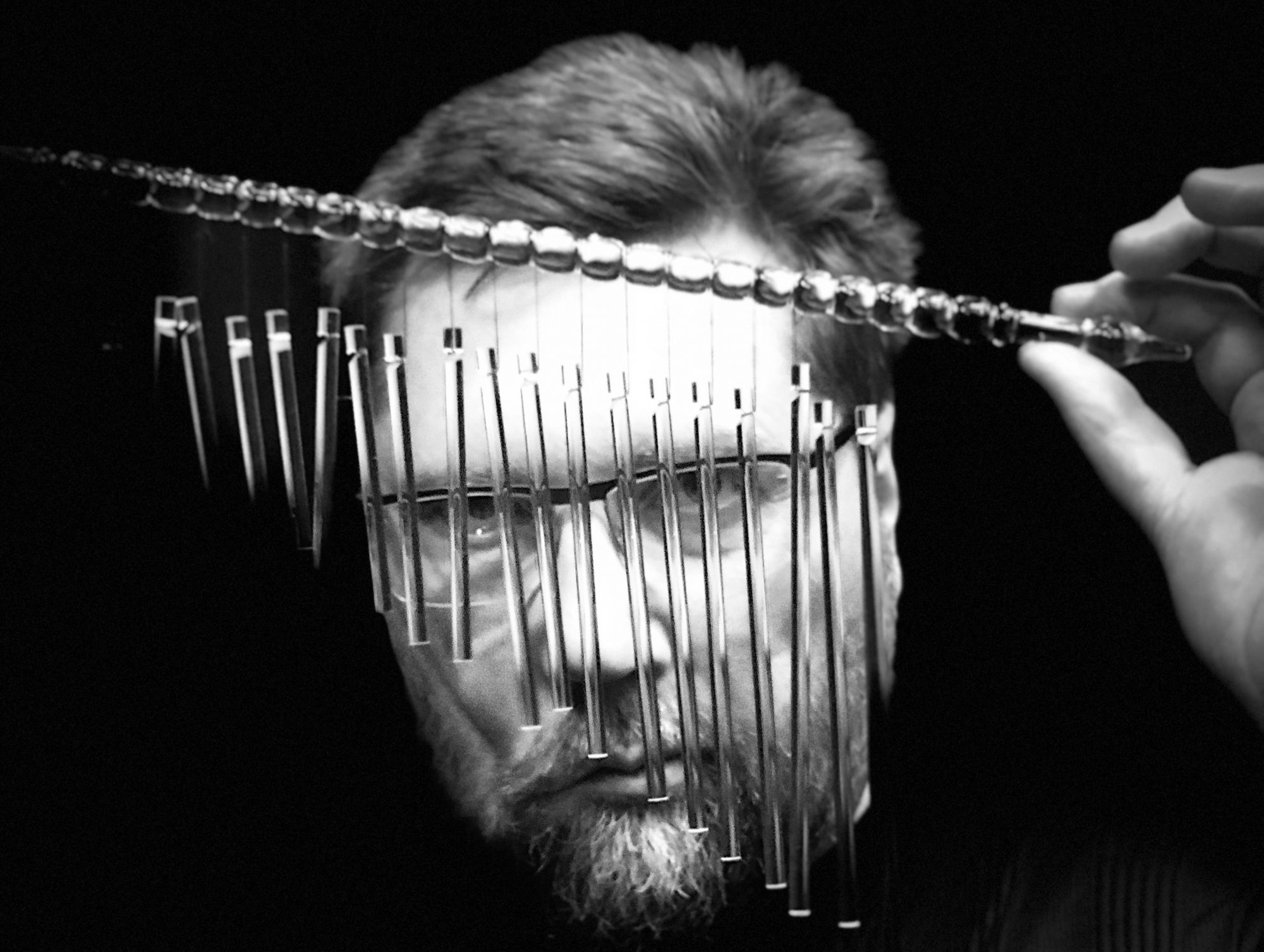
For those of us who are fortunate to be teachers, the start of a new school year brings a mixture of excitement and trepidation. For me a new year represents renewal, a chance to reboot the system software, to rededicate myself to unlocking the unlimited possibilities of young musicians growing and learning together. Pretty cool gig, right?
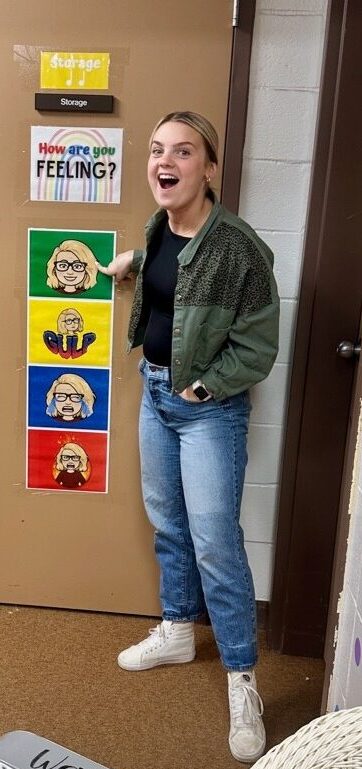
First Day of Classes 2026.
Well, that’s the excitement part, but what about trepidation?
During a recent pre-semester lunch with a colleague, the subject of weight came up in the conversation. Both physical weight of a personal nature and metaphorical weight relating to dealing with the ups and downs of a new school year. He was referring to both students and colleagues who, for whatever reason, shift the weight of their load onto you. This can mean not carrying their own weight in terms of departmental responsibilities or of asking you to carry some part of the weight of their mental or physical wellbeing.
Common sense would tell us that taking even a small amount of someone else’s weight adds a little more to our own. Then think about taking on small amounts of weight from many different people and that burden can quickly add up. If not managed properly this added weight can take a toll on your physical and mental wellbeing. Many people I know have an extraordinary capacity for taking on the weight of others, but there is always a limit and unfortunately figuring that out can sometimes happen too late.
This is not to say that investing time and energy into teaching and mentoring students isn’t a worthwhile endeavor or is something to be avoided. It is quite the opposite. These are the pursuits that every teacher lives for. The hope of seeing that one student—the one who has so much potential yet can’t seem to get out of their own way—living up to the promise you see in them long before they do themselves. This is exactly what I signed up for, and I am happy to take on extra weight in that pursuit just like someone did for me once upon a time.
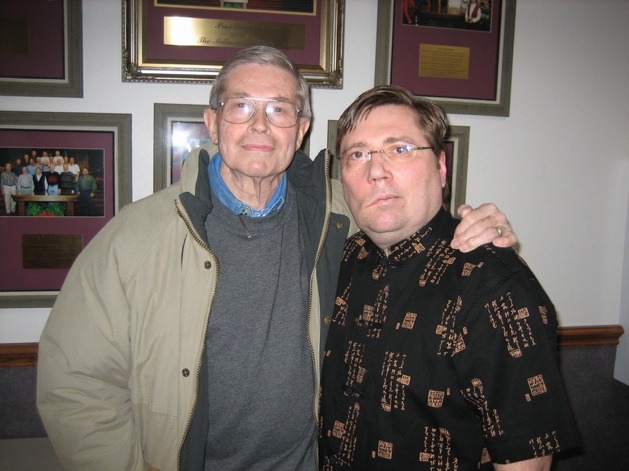
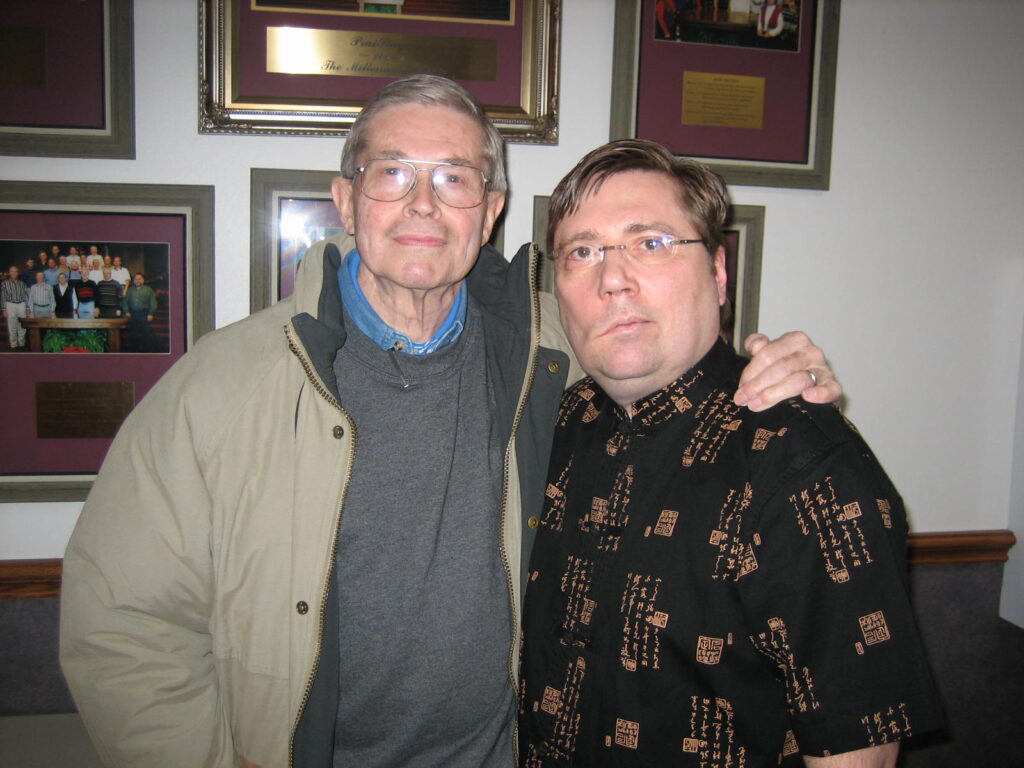
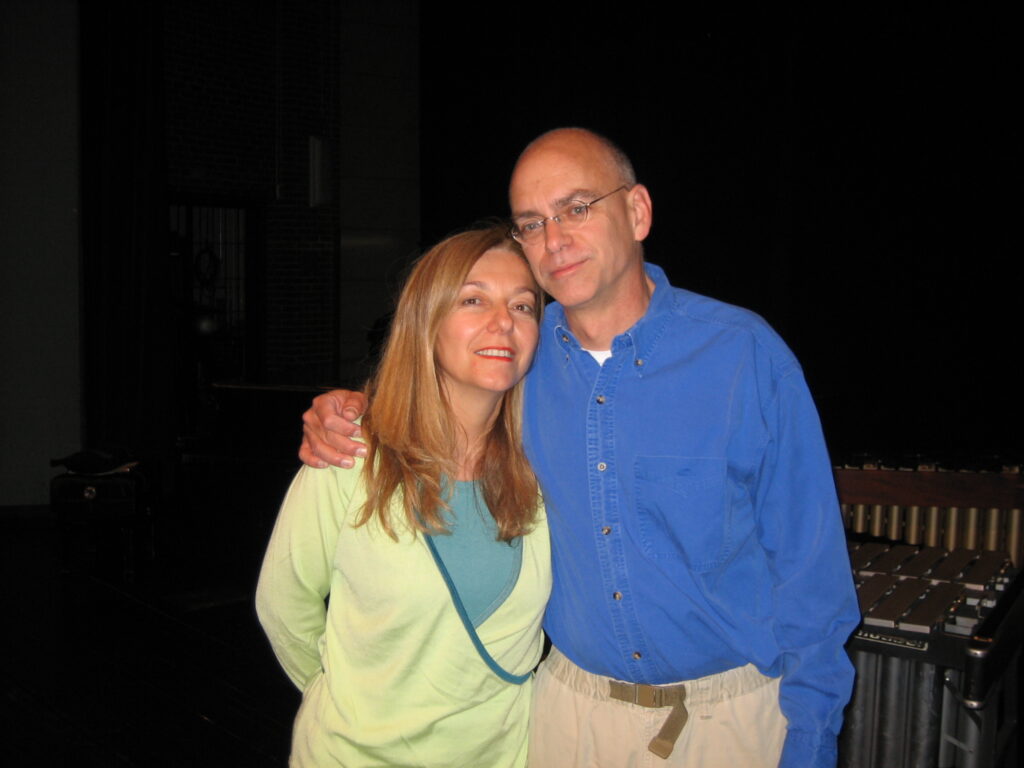
Mr. Jimmy Yancey, my Junior High Band Director who saw my potential long before I did. Mentor and student backstage after a solo concert in 2007.
As my friend and I talked, over our burgers and fries, I understood his point and soon saw myself—as one does—at the center of the scenario. When we left the restaurant, the song The Weight popped into my head.
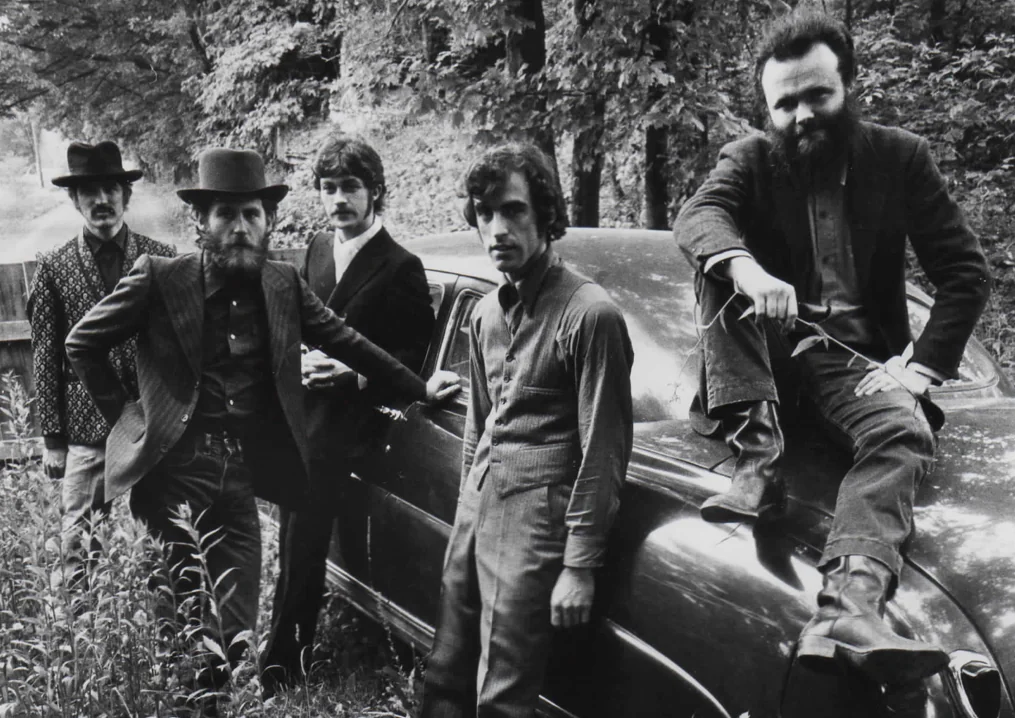
The Weight was released by The Band in 1968. It is about a traveler’s journey to a town called Nazareth and all we know is that he has been asked by his friend Fanny to look up a few people there and give them her regards. But every person he meets makes the task more complicated by asking him for favors of their own which adds a little more “weight” with each encounter. He has taken on this task to somehow alleviate an unknown burden for “Miss Fanny.”
The Band (Left to right: Rick Danko, Levon Helm, Robbie Robertson, Richard Manuel, Garth Hudson)
“Take a load off, Fanny Take a load for free Take a load off, Fanny And (and, and) You put the load right on me” The Weight—Robbie Robertson
In his analysis of The Weight, singer and songwriter Mitch Bradford states that “you set off looking for something, and on the way, you get turned off course. You get mixed up with ‘The Devil or Crazy Chester,’ and suddenly you’re working toward their aims rather than what you set out to do.”
A.I. distilled the message of The Weight quite succinctly. “The physical and emotional weight in the song represents the inescapable obligations, duties, and heavy expectations that pile up when you try to help everyone around you.” Dang, A.I., way to cut right to the point.
Taking on weight from another person is a common thing we humans do, yet it is important to understand that Investing time and energy into another person can only pay dividends if both parties are contributing an equal amount of energy. My friend would call this transaction “energy in; energy out.” In other words, If the energy being put into solving a problem isn’t equal to the transfer of weight being asked of you, it may be time to shift that weight from yourself onto someone more qualified. Referring a troubled student to a health-care professional is often the best thing you can do for them.
And much like our traveler, the weight of other people can indeed knock you off your own course. This is a lesson that educators learn the hard way, and in many cases, long after it is too late to do anything about it. Exceeding your weight limit too much for too long can cause burnout.
Teachers, counselors, psychiatrists, pastors, therapists, and many other individuals who care deeply about their charges are the most susceptible to varying degrees of burnout. A psychiatrist friend once told me that most every therapist ends up talking to someone else at some point during or at the end of their career to help them lose some of the weight they’ve taken on during their practice (he told me this upon the occasion of his retirement). Even Ted Lasso’s shrink has a shrink. Think about that for a minute.
But I come from a generation of people who, by virtue of the era in which we grew up (the 60s and 70s), have a predisposition to help. Just consider the music we listened to when we were coming of age and it will provide insight into our propensity for taking on the weight of others. Songs such as Lean on Me, With a Little Help From My Friends, Help Me Make It Through the Night, You’ve Got a Friend, Bridge Over Troubled Water, and He Ain’t Heavy, He’s My Brother are just a few of the songs that helped define us as a generation in addition to informing our attitudes about helping others first and everything else second.
In 1969 Glen Campbell sang:
“If you see your brother standing by the road With a heavy load from the seeds he sowed And if you see your sister falling by the way Just stop and say, “You’re going the wrong way”
“You’ve got to try a little kindness Yes, show a little kindness Just shine your light for everyone to see And if you try a little kindness Then you’ll overlook the blindness Of narrow-minded people on the narrow-minded streets” Try a Little Kindness—Curt Sapaugh & Bobby Austin
But in our desire to help we must also remember that there is a danger in thinking that we can “fix” a person who is really struggling. As mentioned above, taking on a little extra weight for a person who is trying to push through a rough patch is a worthy cause, but trying to “fix” someone who is unwilling or unable to match the energy you are expending—the weight you are carrying for them—is a risky proposition.
There comes a point where you realize that only a trained professional can help a person manage their burdens — their own weight. Giving that weight to someone more capable of helping is the best thing you can do for everyone involved.
It’s always good to check in with your students, mentees, family, and friends to make sure they are in a good space..
The bottom line is to never stop asking for help and never stop offering help to anyone who asks, but keep an eye on the scales for when that extra weight becomes too much.
It’s also a good idea to check in with your students, mentees, family, and friends from time to time just to make sure they are in a good space.
One thing to remember is that sometimes all a person might need is a friendly smile, someone to listen, and a nice “cup of pep talk.”
“A Cup of Pep Talk” from the bulletin board of one of my favorite Iowa elementary schools.
Citations:
Bradford, Mitch. “The Weight” by the Band – History of a Song in 60 Seconds,” YouTube Video, September 15, 2023
Robertson, Robbie, “The Band … the Weight 1969 @ Woodstock live”, YouTube, April 25, 2010
Robertson, Robbie, The Weight, Remastered, Producer, John Simon Mastering Engineer, Dan Hersch Mastering Engineer, Andrew Sandoval, Capitol Records, 2000
Sapaugh, Curt. Austin, Bobby. Try a Little Kindness, Capitol Records, United Records, single recording by Glen Campbell released October 1969
It’s DCI Finals week and I am reminded once again that when Drum Corps gets into your system it is hard to get it out. Every summer, it seems, I feel the pangs of youth when I begin to see the drumline lot videos popping up online. After all these years I still have vivid dreams that I’ve been called back into service as a drumline caption head looking for a quiet place to warm up the line (not nightmares, just pleasant memories). Drum corps was among the most rewarding, exciting, edifying, and frustrating experiences of my life in music.
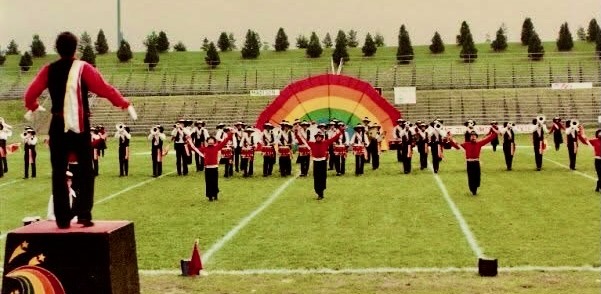
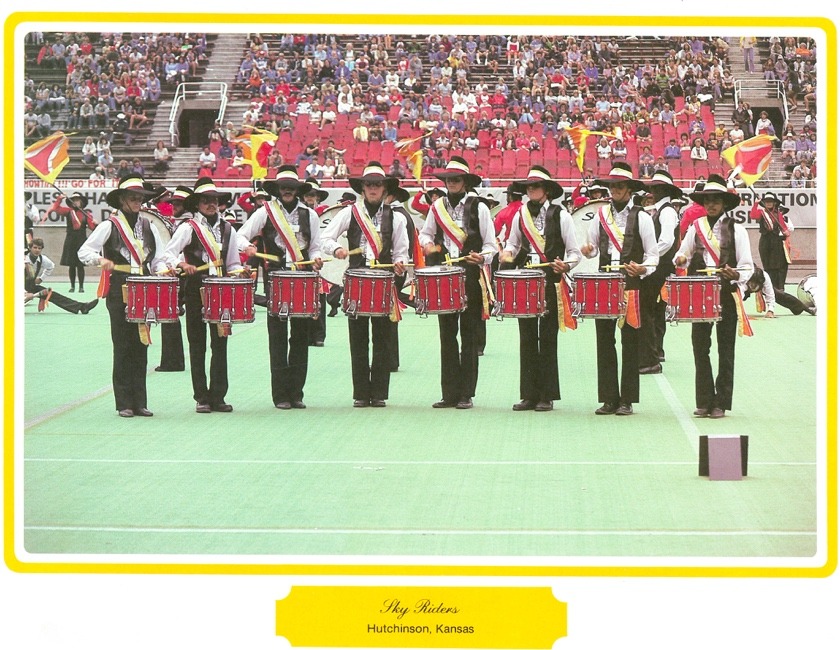
The corps that gave me my moment of drum corps fame was the Sky Ryders of Hutchinson Kansas. From 1981 to 1983, I worked my way up the ladder from snare tech to percussion caption head and percussion arranger which culminated in our first two years as a Top-12 finalist at the Drum Corps International (DCI) finals.
You can read about our storybook 1982 season here.
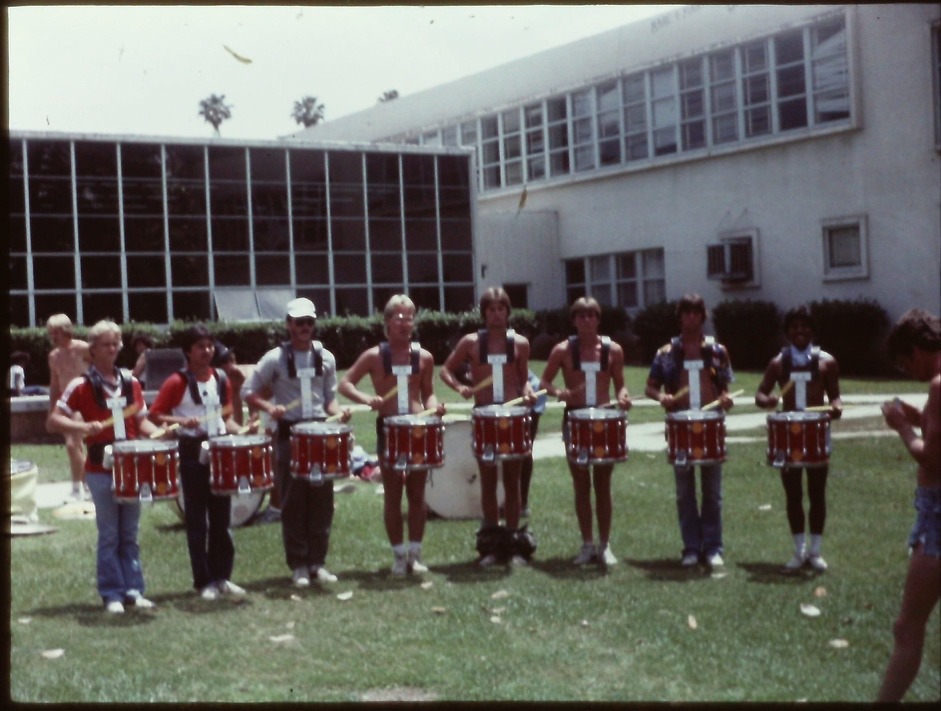
Sky Ryders snare line warming up and looking good already, 1982.
But at the end of the 1983 campaign, the handwriting was on the wall for me when I was told that the board (or someone) wanted Ralph Hardimon (then the caption head for Santa Clara Vanguard and my good friend) to write the drum book for the 1984 season. But as a young hothead, I told them that I didn’t want to clean someone else’s drum parts and I effectively retired myself from drum corps (well almost). I didn’t see another drum corps show until 1993.
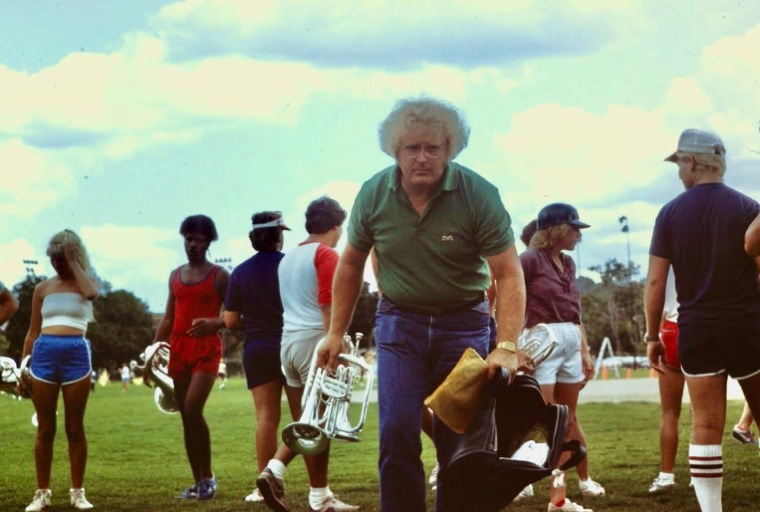
Legendary horn instructor and DCI Hall of Fame Member, John Simpson in his element (1942-2025).
At the time I didn’t know that the Sky Ryders had also let go the luminary corps director George Tuthill (World Drum Corps Hall of Fame member who orchestrated our rise to the Top-12) and John Simpson (legendary horn instructor and DCI Hall of Fame Member).
The next season, the corps finished in 17th place, exactly where they were in 1980; the year before I came to Hutchinson. I guess you have to prune something back before it can grow again because the Sky Ryders would come back stronger several years later with three more appearances in the Top-12, including their highest ranking of 9th place in 1986. In 1991 the corps placed 10th after relocating to DeSoto, Tx, but unfortunately that success didn’t last and the corps finally folded in 1994.
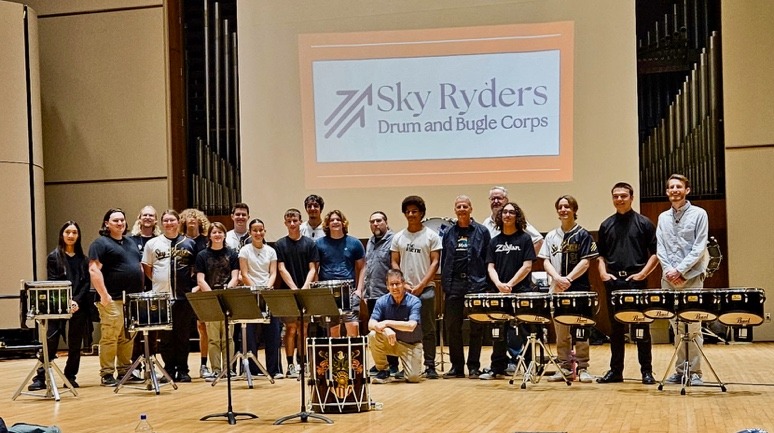
The current Sky Ryders website states that “twenty-nine years later, Sky Ryder alumni led by Dr. Jay Smith founded the Sky Ryders Performing Arts Foundation (SRPAF) in Hutchinson, with the intention of bringing the Sky Ryders back to the community where it began over seventy years ago.” I was happy to see the corps getting back on the field in Kansas and enjoyed the opportunity, at the 2026 Kansas Day of Percussion, to see and hear part of the drumline prior to their move-in day a few months later. They were excited to continue working their way (once again) up the ladder of DCI. “It was ever thus,” I thought to myself as I wished them the best of luck for the coming season!
Sky Ryders drumline and staff with alumnus Russ Chandler and percussion coordinator Eric Sheffler.
I was also pleased to learn that there are many people from my era involved in the revival of the Sky Ryders including, among others, Mary Searcy-Price, Russ Chandler, Craig Coldren, and Eric Sheffler (a bit before my time in Hutch).
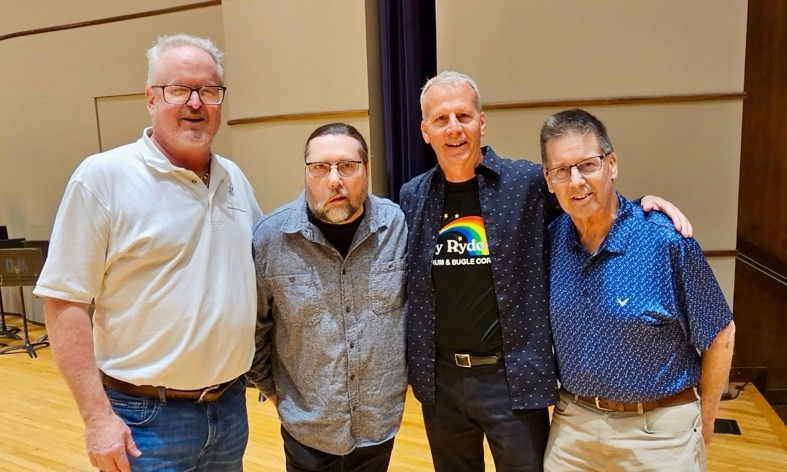
Kansas Day of Percussion 2026 with Mat Britain, Eric Sheffler, and Russ Chandler.
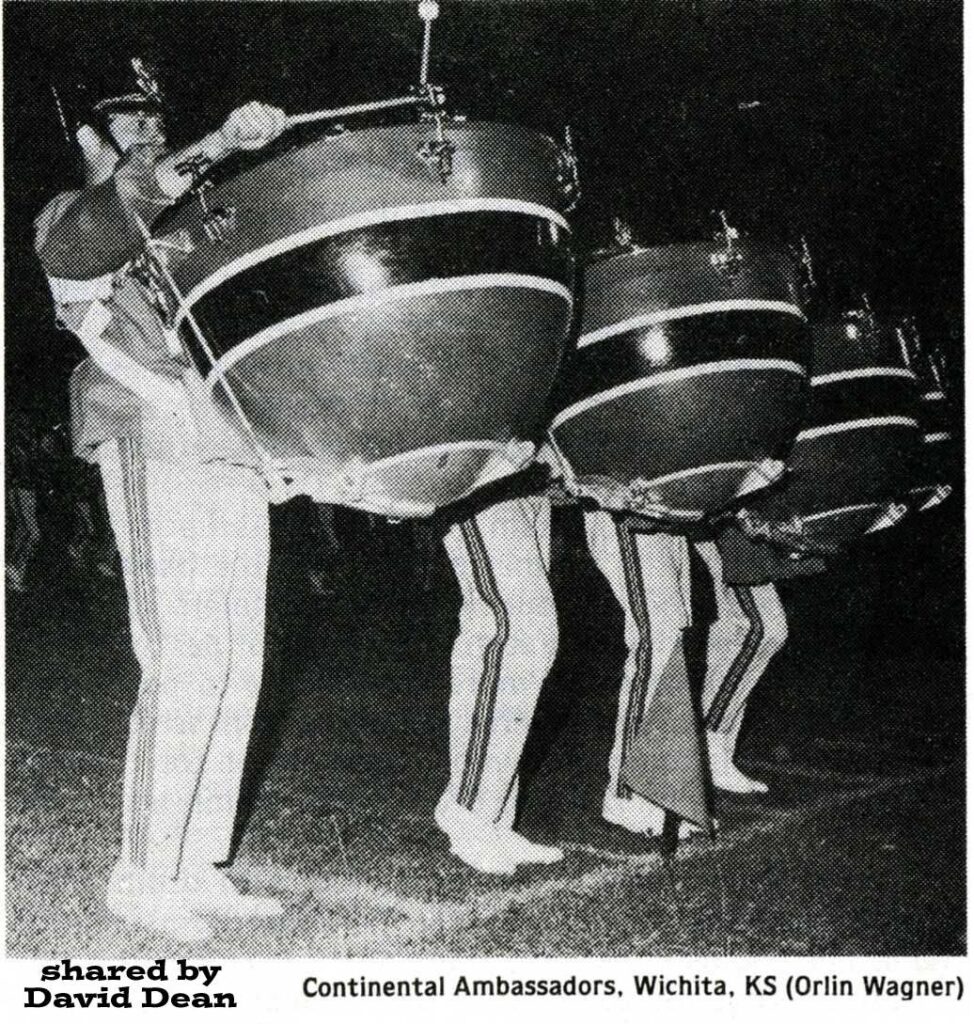
Before their move to Texas, the Sky Ryders were perhaps the only remaining drum and bugle corps in Kansas. Once upon a time Kansas corps included the Argonne Rebels, Salina Silver Sabres, and the Frontiersmen and Trailblazers of Overland Park. In Wichita there were the Plainsmen, Phantom, the Scarlet Lancers, and the Continental Ambassadors. Phantom and the Scarlet Lancers later joined forces with the Continental Ambassadors to form an active and successful corps in the 1970s.
Nothing better than a marching timpani section, but the Continental Ambassadors had a good one back in the day
I say that I “almost” retired from drum corps because in 1984 I served a brief stint as director of the Continental Ambassadors while the corps was trying to reform again. We had a good off season with about 30 kids until we learned that the parents of two corps members were embezzling money from the bingo game. The corps declared bankruptcy then folded once and for all. My retirement from drum corps was complete.
A few years ago, I was asked to sit for an interview with Sky Ryder alumnus Rich Garcia to talk about the 1982 Sky Ryders for a virtual tour. One of the questions he planned to ask was about my proudest moments from the 1982 season. That was going to be a challenge because there were so many accomplishments that had already been talked about during the course of the virtual tour.
It was fascinating to follow the virtual tour and read the recollections of those who shared our journey. I didn’t want to recount anything that had already been discussed—hardships, turning points, moral victories, literal victories—so it was going to be difficult to find something new to say. Or so I thought. I was proud of all our many accomplishments. The Sky Ryders were innovators in body movement, storytelling, acrobatics, development of the front ensemble, percussion ensemble influenced drum solos and many other advancements that are common today. The rifle line alone redefined what it meant to “twirl” a rifle. But there was one more thing.
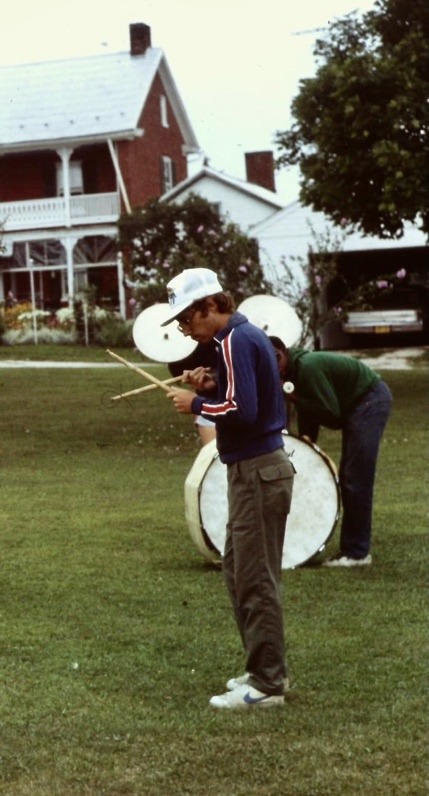
Clicking sticks in 1982, Any Town, USA.
As the interview was nearing the 2-hour mark, I remember thinking that we hadn’t actually gotten to the question of my proudest moments in direct terms. But there was something that I was especially proud of. It had been in the back of my mind for a long time, hadn’t been talked about, and needed to be said.
When I think about what was most meaningful to me during my time with the Sky Ryders, what I remember most, is that when I looked at the group of people who comprised that corps, I saw black faces, white faces, and brown faces. There were young men and women ages 14 to 21 who lived, worked, and travelled in (very) close proximity for more than three months. They endured hardships and adversity, faced down their fears* and insecurities, and made their presence known to the drum corps world.
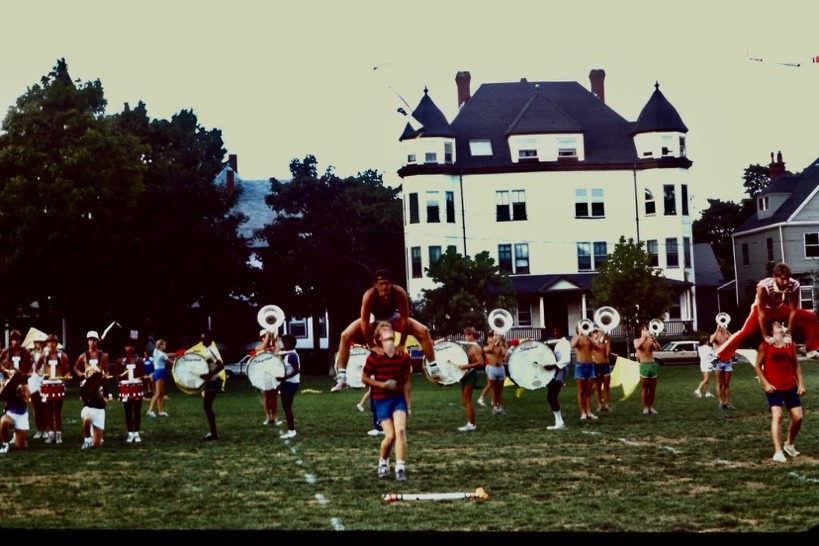
*Perhaps a fear to overcome would be trying to catch a spinning three-pound wooden rifle thrown 20-feet into the air while looking into the sun as another person is leap-frogging over your shoulders; for example.
Today, there are so many things in this world that are used to divide people. Race, religion, age, gender, and sexual preference are all weaponized to keep us apart and distrustful of one another. But to the Sky Ryders, none of those things mattered. One of the corps members from 1982 told me that “I don’t remember race, diversity, or inclusion being addressed, talked about, or even an issue with the Sky Ryders, but that’s from my perspective as a white person. I think we were just so focused on the task at hand and pulling together as a team. What mattered most was working together and looking out for each other.”
Yet people of different races experience things differently. We all have unique vantage points to observe history. For example, I didn’t immediately recall the circumstances of our midnight departure from a certain town due to the actions of a few drunken cowards shouting racial slurs from the shadows outside our host school. I asked one member of color if he remembered the incident, but he didn’t. He had joined the corps only a few days earlier and was probably already passed out from exhaustion. But another person remembered the incident quite clearly. She recalled that it was a “frightening situation.”
But that night George let the local constabulary know that he was not happy about the welcome we were receiving from their “friendly” town before saying “we’re leaving.” And away we went—complete with a complimentary police escort. At that point in the season, everyone was so conditioned to just start moving whenever corps manager Mr. Bill said, “pack it up, we’re leaving in 30-minutes.” I’m sure most people were unaware of why we were departing so suddenly, but George, a native New Yorker, just couldn’t stand being there any longer because “where some of us weren’t welcome, none of us were welcome.” It became a galvanizing moment in our story that only strengthened our bond.
The Sky Ryders never judged each other by the color of their skin but by the content of their character (I’ve heard that phrase somewhere before). Possessing the ability to accept instruction and show measurable improvement in a reasonable amount of time was the only criteria to be a Sky Ryder. If those characteristics were embodied within a good soul, we could help them develop the skills necessary to “imagine our desired outcome” (as the Inner Game of Tennis would teach us).
Clearly having a philosophical discussion with the bass and cymbal line about something important, 1982
Well-meaning people say, “I don’t see race; I don’t see color.” But that isn’t really true, is it? Everyone sees difference. The real distinction is how you react to those differences and how you treat people. Yes—the content of your character! The Sky Ryders’ reaction to difference was always “So What? Let’s go practice.”
Back in the day the Sky Ryders were known as the Rainbow Corps even before rainbows were a thing. Most people thought it was because of the whole “Wizard of OZ, Somewhere Over the Rainbow” vibe from a proud Kansas drum corps. Maybe so, but it means so much more. Not as some political statement but as a manifestation of the true American ideal in action.
So, in a few days DCI finals will be over and another winner will be crowned. The memories from the best worst summer(s) of your life will fade into the background once again. It’s just good to know that the friendships and memories of a summer long past and the group of people you shared it with will stand the test of time in your memories. Whenever you hear that “certain song,” or maybe once a year on March Fourth, or during Finals Week, those memories will come rushing back. You’ll smile, maybe wipe away a tear, and remember…
“I have a dream that my four little children will one day live in a nation where they will not be judged by the color of their skin but by the content of their character.” —Dr. Martin Luther King Jr.
The 4th of July always brings out my patriotic side, and on our 250th even more so. For one thing, I got to experience the Bicentennial as a high school senior in 1976, and I am happy to still be around to celebrate the semiquincentennial. But what does that have to do with how I became a drummer?
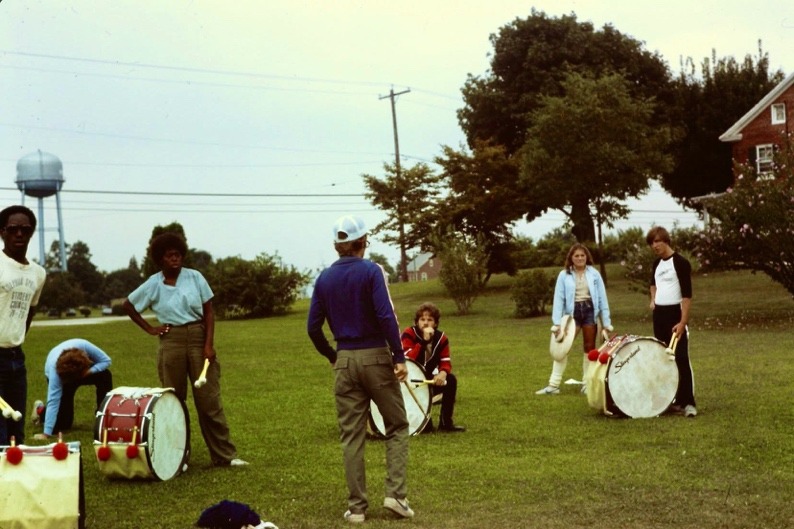
Well, like many poor and awkward kids growing up in East Texas, I wanted to find a place to fit in. I tried sports (as you do in Texas) but was not particularly athletic. My academic credentials were less than stellar, and I had begun to fall in with the “wrong crowd” of neighborhood “rough kids.” In hopes of saving me from my unsavory associations, someone suggested that maybe I should join the band. I thought it was a great idea since I was already a fan of the popular trumpet player Herb Alpert, and because I had zero interest in anything else. Maybe it would be cool to play trumpet and be the de facto leader of the band, so I gave it a try.
But as it is often said, an “instrument finds you, not the other way around.” You can force a child to choose the piano but very few will be chosen “by” the piano in return. Turns out it was the same for the trumpet. As you might have guessed, the trumpet did not choose me on band instrument selection night, but the drums somehow did—like it or not.
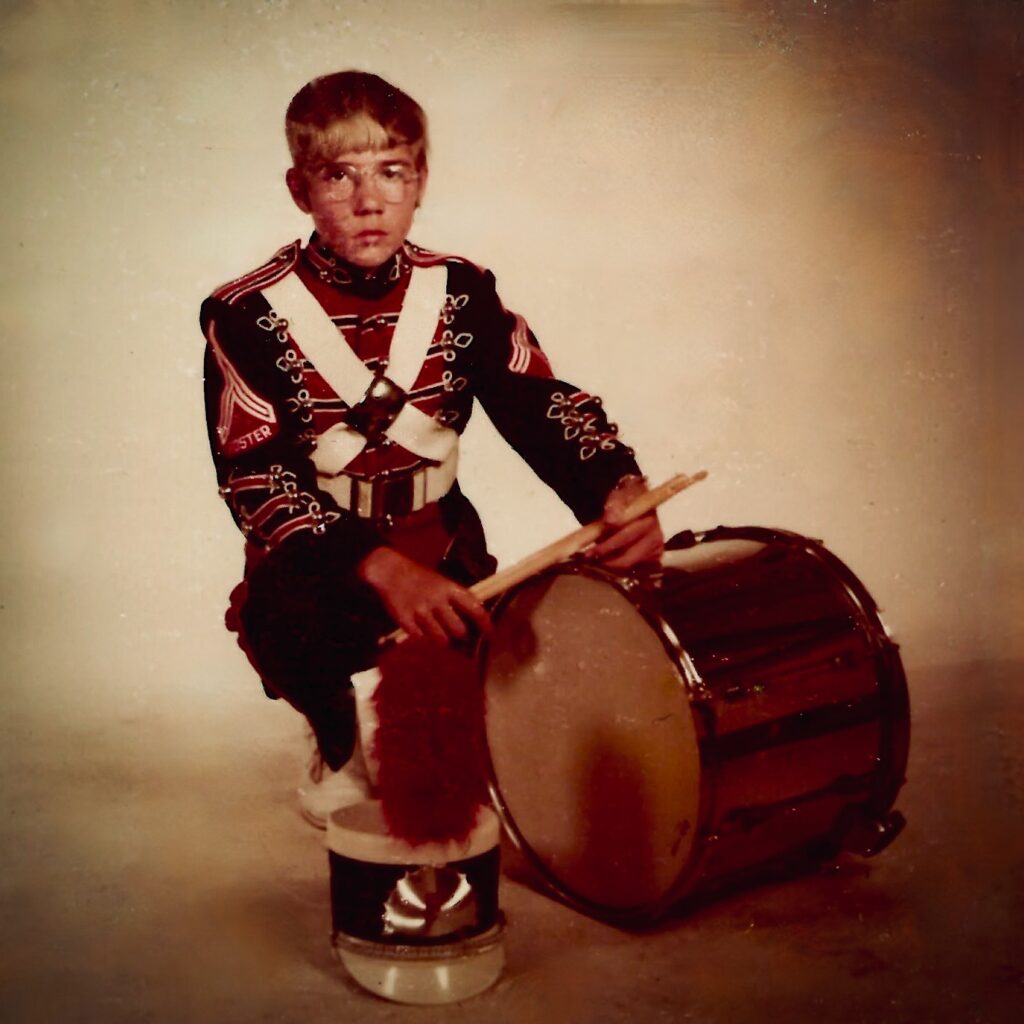
The trumpet did not choose me on band instrument selection night, but the drums somehow did. The Author circa 1972
From that day in 1969 forward, I have held a pair of drumsticks (or at least carried them in my back pocket) for well over the generally assumed 10,000 hours thought necessary to acquire mastery of a particular skill. In his Book Outliers: The Story of Success, Malcolm Gladwell called this the “10,000 Hours Rule.” He also considers other factors related to success such as family, culture, access to resources, and desire, however the 10,000 Hours Rule remains a handy marker.
Along the way toward achieving those hours, it eventually occurred to me that being a drummer was somehow baked into my DNA; I just didn’t know it, and neither could I avoid it. But what does that mean exactly—to have drumming in your DNA? No one in my family was or had been a drummer or musician of any kind for that matter. I’m talking about spiritual ancestors. These are people who influenced you or your profession either directly or indirectly. Some are people you know, many are not. Folks who were drummers long before you were born so that you might have the opportunity to become one.
Recently, I found myself scrolling through my Facebook feed when I came across a group of young musicians who were doing a promotional video for their band’s upcoming concert. The video was simple; as the camera panned down the line, each player introduced themselves. The first one said something like, “I’m Alex, I play sax.” The next one said, “I play guitar.” The next, “I’m THE Singer” (about par for the course I suppose), but the last band member looked into the camera and said, “I’m a drummer.” That small moment resonated with me. Without thinking, he was saying “I don’t just play the drums,” he said, “I AM A Drummer.” That’s something entirely different. When you recognize that being a drummer is part of who you are rather than something you simply “do,” it is a powerful self-realization. It’s in your DNA. You can’t take it out and look at it. It’s just there and you feel it, eventually.
I am always proud to be a drummer, but even more so on Independence Day. As the 250th anniversary of our Nation’s birth drew nearer, it got me thinking about the brave drummers of the Revolution and the Civil war. For years I have been fascinated by the role (or roll) that drummers played in the history of our great nation.
The early American drummers have a rich history that I can—and often do—talk about at length. As a teacher, I feel a responsibility to honor the memory of drummers of the past and to pay our respects to them for their many sacrifices in service to our country. I love telling the story of the ancient drummers and their importance; beating out calls and signals during battle, marching troops from place to place, as lifters of morale among the soldiers, and many other duties.
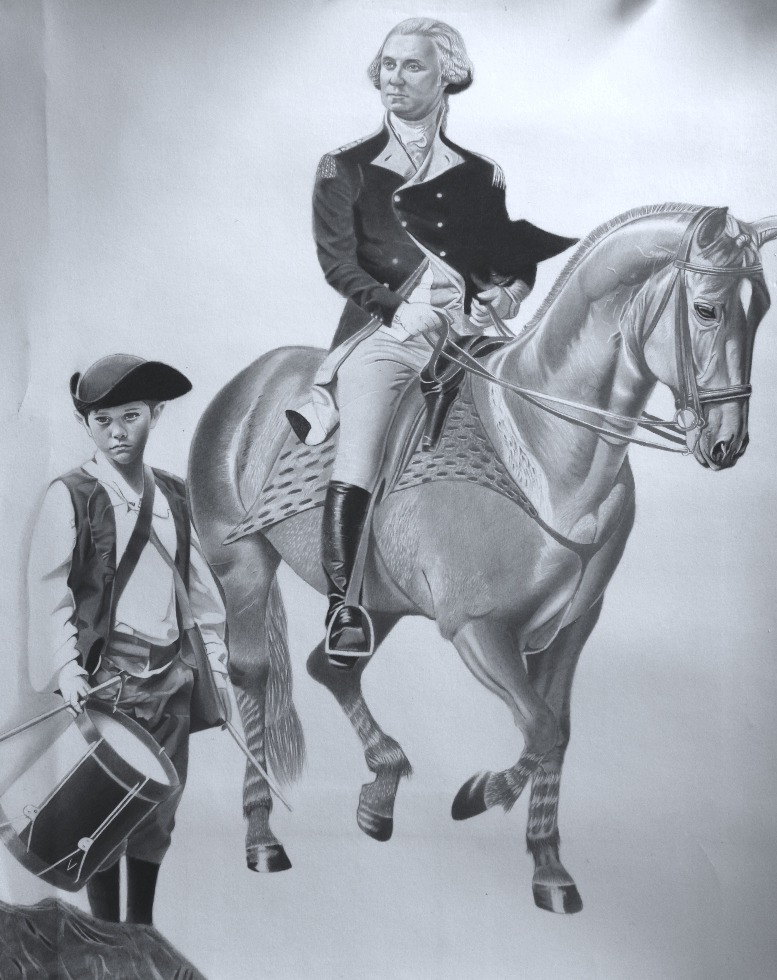
Billy Simpson, George Washington’s drummer. Illustration commissioned from Martins Isaiah Aogi of Billy and George Washington
But when telling their story to an audience, the most visceral reaction comes when they learn that the average age of drummers in both the Revolution and the Civil War was 12. These boys were considered too young to do the fighting, so drumming would be the best job for them. Yet as it turns out being a drummer was an even more dangerous proposition. Many of these young men, often known as Washington’s Drummers, were killed on the battlefield by the enemy in an attempt to knock out communications and demoralize the soldiers. When I was 12, I had just been handed my first pair of Ludwig 2B drumsticks and had no clue about what to do with either one of them.
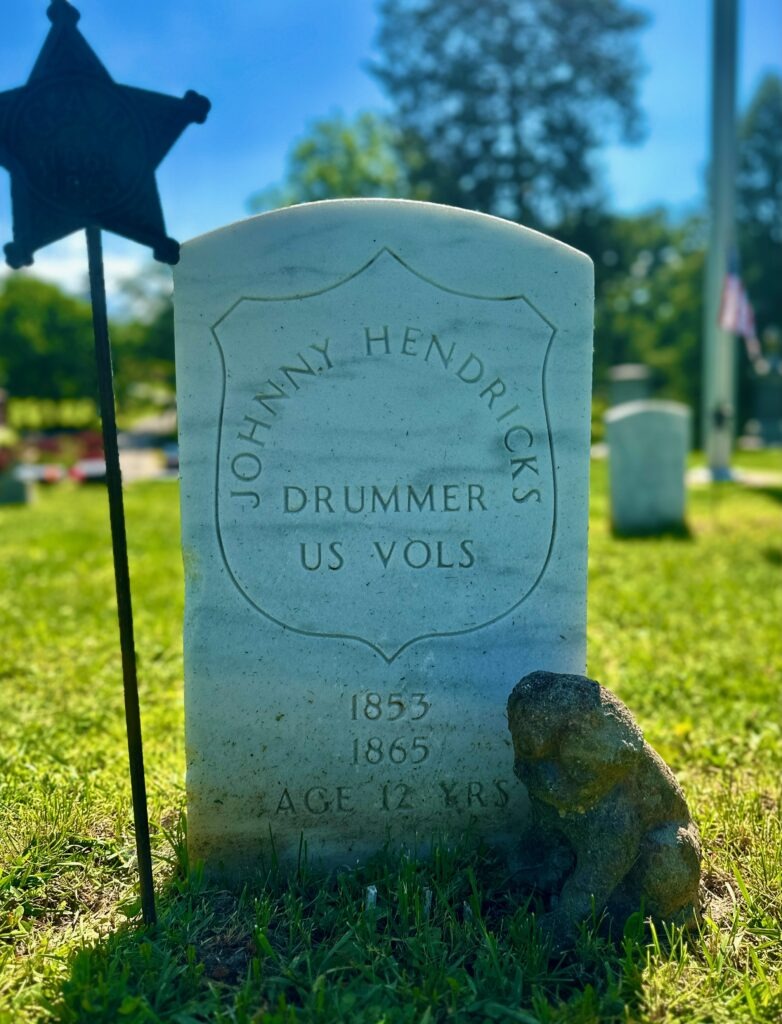
Johnny Hendricks, Drummer, US Vols, 1853-1865, Age 12 Yrs. Iowa City, IA, Memorial Day 202
This summer I decided to do some ancient rudimental drumming during our performances at the Birch Creek Music Performance Center in Door County, WI., and as I was planning repertoire for the season, we decided to take a break to attend a local Memorial Day Ceremony in Iowa City. While in the cemetery we decided to pay our respects to some of the Civil War era soldiers buried there. The first headstone we found read: Johnny Hendricks, Drummer, US Vols, 1853-1865, Age 12 Yrs.
Here was empirical evidence of something I had been saying for years, right there in front of me and in my own back yard. Johnny Hendricks lived as a drummer and died as a drummer. He was a drummer—a spiritual ancestor I’d never heard of.
And even though I spend more of my time these days behind the marimba or the vibes, I am still a drummer.
Happy 250th 4th of July!
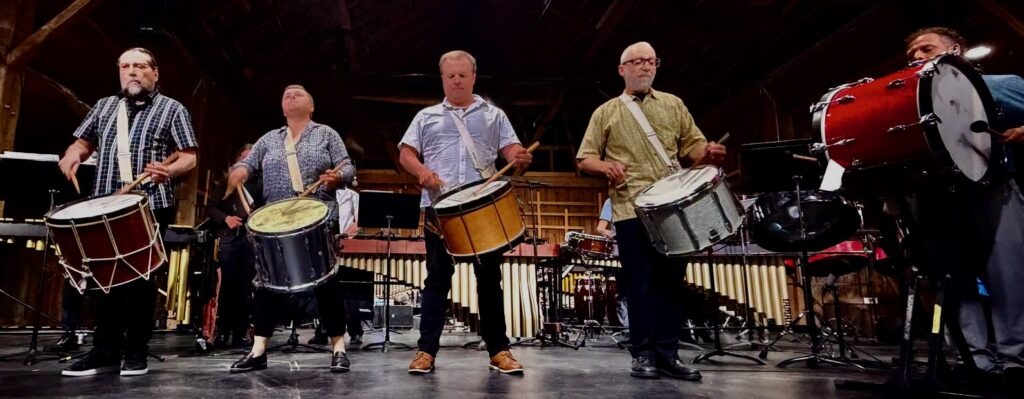
Drumming The Three Camps at Birch Creek 2026, L-R, The Author, Michal Sue Brauhn-Damm, Peter Naughton, Anthony DiSanza, Scott McConnell. Photo: Laura Smith
Citations:
Gladwell, Malcolm. Outliers: The Story of Success, Little, Brown Paperbacks, June 7, 2011, ISBN-10 : 0316017930, ISBN-13 : 978-0316017930
Today’s blog post asks the question, what do drummers and the Olympics have in common? More than you might expect actually, so read on my friend, to receive enlightenment.
February was full of talk about the Olympics which seem nearly as ubiquitous as elections these days since both come around every two years like it or not. Alternating between Winter and Summer, the games fill our television screens, laptops and iPhones with amazing feats of physical strength, balance, dexterity, and grace under pressure.
“If there was no one on Earth, I would still skate.” Alysa Liu performs her free skate at the US figure skating championship in Wichita, Kansas in 2025. Photograph: Matthew Stockman/Getty Images
Most all the skills that are on display at the Olympics are those that normal humans don’t possess. Events like cross-country skiing (the worst sport ever invented, based on my experience as a former Montanan) and curling, which has somehow captured my (and everyone else’s) imagination during this year’s games, feature skills far above that of the average person! Even curling which is evidently the province of extremely limber soccer moms who yell a lot.
Photo by: USA Today Sports
The first Olympic games took place in Greece in 776 BC but were ended in AD 393 by the Roman emperor Theodosius I, who was probably very unathletic and didn’t look good in spandex sportswear. Then, in the late 1800s a Frenchman named Pierre de Coubertin brought the games back to life and in so doing, introduced the motto of the modern Olympics: Citius, Altius, Fortius which translated from Latin means “Faster, Higher, Stronger.”
Beyond the obvious comparison that drummers are also big fans of the idea of “faster, higher, and stronger,” there are other aspects of Olympism that resonate with the drumming community.
According to the World Olympic Association (WOA), “as Coubertin was planning the modern Olympic Games in the 1890s the idea of Olympism became more clearly defined. In the Olympic Charter it is expressed as ‘a philosophy of life, exalting and combining in a balanced whole the qualities of body, will and mind. Blending sport with culture and education, Olympism seeks to create a way of life based on the joy of effort, the educational value of good example, social responsibility and respect for universal fundamental ethical principles.’”
Let’s put this another way. “Blending sport [i.e. drumming] with culture and education, Olympism [drumming] seeks to create a way of life based on the joy of effort,” drumming, check, “the educational value of good example,” again, drumming, “social responsibility and respect for universal fundamental ethical principles.” Well, that’s what drumming is all about, Charlie Brown.
But what else do drumming and the Olympics have in common?
Several years ago, Russell Hartenberger of the Percussion Group Nexus wrote a blog post entitled “Snare Drum Olympics.” In the post he writes, “[w]hen I taught percussion at the University of Toronto, I encouraged the first-year students to spend a large portion of their practice time on snare drum. However, as I began to assign them repertoire on other percussion instruments, I saw that their attention to snare drum dwindled. In order to encourage them to continue practicing snare drum, I came up with the idea of an annual Snare Drum Olympics.”
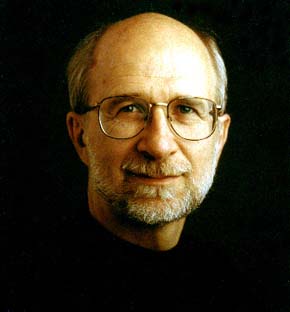
Professor Emeritus and former Dean of the Faculty of Music, University of Toronto.
Russell goes on to say that the idea for the Snare Drum Olympics harkened back to his days as a student and a “shameless prank” he “perpetrated with a fellow percussionist” at the Curtis Institute in the 1960s.
I should just let Russell tell you the rest of the story:
“The percussion studio at Curtis at that time happened to be right next to the music theory classroom. One of the rules at Curtis was that personal practice took precedence over everything else, so my friend and I knew that we could play as loud and long as we wanted in the percussion room and no one would tell us to stop. One day, while a music theory class was in progress, my percussion buddy and I decided that we would play a fortissimo snare drum roll for the complete hour of the class to see if we could get away with it. No one stopped us, as per Curtis regulations, so we rolled non-stop for an hour. I confess that we varied our dynamics so we weren’t constantly playing as loud as we could, but we didn’t stop playing for an entire hour.”
“The excitement of this shenanigan helped me keep up the energy to roll for an hour, but I realized I also had to make some physical and mental adjustments to stop tension from building in my hands and arms. I discovered that if I began to feel my hands tightening, I could move the tension to other parts of my body by focusing on the affected area, breathing into it and mentally shifting the tension to a different muscle group. A few years later, when I started practicing yoga, I learned that this is one of the principles of that discipline, and I began to experiment with it in other areas of my percussion playing.” —Russell Hartenberger
I discovered that if I began to feel my hands tightening, I could move the tension to other parts of my body by focusing on the affected area, breathing into it and mentally shifting the tension to a different muscle group.
Russell Hartenberger
The concept of repetition and building stamina in drumming is a time-honored tradition. In the early 1970s and some 1400 miles away from Philadelphia and the Curtis Institute, in an East Texas schoolyard, my best drumming friend—slash—arch rival for chair placement in the Junior High School band and I used to meet up after school to try and see who could roll the longest on a snare drum without stopping.
Of course, there would always be a small cadre of curious onlookers there to view our “shenanigan” and cheer us on including, of course, some cute girls we were trying to impress. Regardless of the motivation for our Snare Drum Olympics, it served the purpose of helping us develop patience, control, and endurance for extended drumming in the same way that Russell had discovered shifting tension to different parts of his body just a few years earlier.
We might’ve thought that an hour-long roll would probably contribute to helping us make a two-measure roll sound pretty good or maybe just improve our chances to get a date for the skating rink on Saturday night (note: it didn’t) but at the time we were mostly interested—as you might imagine—in the whole citius, altius, fortius paradigm. One thing for sure is that playing faster, higher, and stronger for long periods of time paid dividends for us as drummers later on.
When I got to college, we started an “afterhours long-roll club” after a friend of mine came back from the Navy School of Music and told us about the techniques they used for roll development and stamina. It was a more regimented approach that involved sustaining an open double stroke roll at around 80-90 beats per minute for an hour. We would focus on the right-hand pulse for ten minutes then shift the focus to the left hand for ten minutes and repeat this sequence for an hour. After the first round, we would take a break to goof off around the music building and then set the metronome 5-beats per minute faster and roll as long as we could. The last drummer standing was declared the winner of the night. Citius, altius, fortius,ego sum victor (to keep it in the Latin vibe)!
Hartenberger’s Snare Drum Olympics were so successful that they became an elaborate yearly event that continued through to his retirement from the University of Toronto. You can read more about their three-day spectacle here: https://www.nexuspercussion.com/2021/03/snare-drum-olympics/
The Britain Moore Duo just moments before a breakout of the “timbale Olympics” at the Cincinnati Waterfront on the Ohio River, circa 1993. Bassist Bill Jackson seems less excited about the impending display…
In another (less serious) example of the Olympic influence on percussion, my duo partner Mat Britain and I used to have a part of our performances that we referred to as the “Timbale Olympics” in which we battled over a pair of timbales in a loosely choreographed rhythmic dance. It always brought the house down because it was a show of drumming skills that were (you guessed it) faster, higher, and stronger than that of normal humans. At least our audiences thought so. It remains a term to describe the omnipresent timbale solos heard at nearly every Iowa Steel Band Performance.
The fact is that there may never be drumming in the Olympics, but if someday it happens, just know that we drummers will be ready! Citius, Altius, Fortius, Ya’ll!
And one more thing before we go:
Russell Hartenberger wrote about his energy-shifting technique in an article titled “A Different Kind of Virtuosity,” for the book, The Cambridge Companion to Rhythm. In it, he describes energy-shifting in this way:
“In playing [Steve] Reich’s music and West African drumming, I use something I call energy-shifting, a technique I developed from practicing yoga postures and breathing exercises. I find that it is necessary to have a certain amount of tension while playing in order to produce a strong, centered sound, especially when I have to generate this sound with consistency over long periods of time. In order to prevent tension build-up, I keep up the necessary energy by shifting the tension around in my body. For example, if I feel tension mounting in my wrists, I concentrate on releasing the tightness by focusing my breathing in that area and allowing my arms or another part of my body to absorb the tension. By practicing this technique, I developed the ability to energy-shift quickly and easily.”
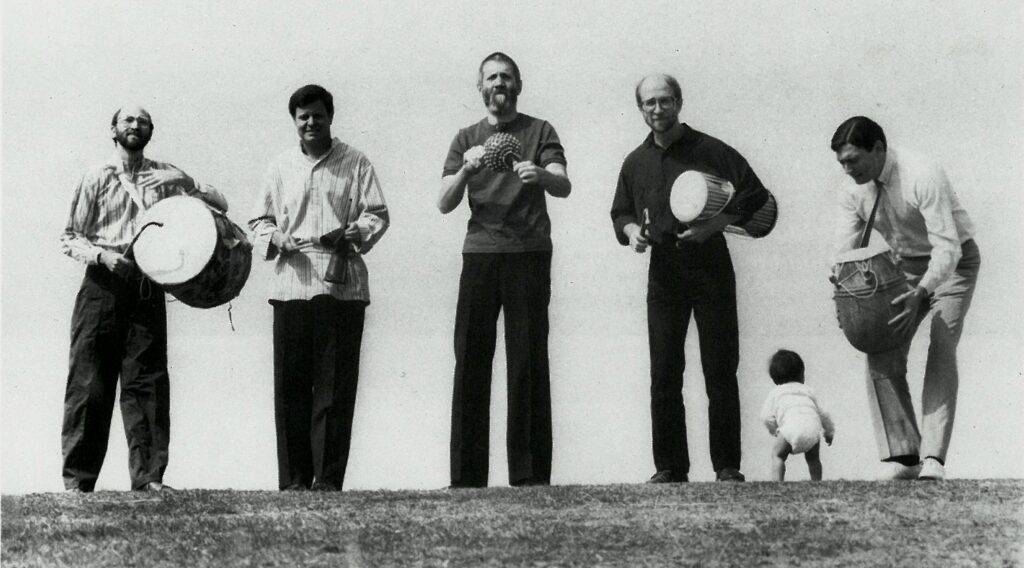
NEXUS, African drumming circa 1986. L to R, Bob Becker, the late Robin Engelman, the late John Wyre, Russell Hartenberger, unidentified dancing baby, and William Cahn.
Citations:
Li, Helen. ‘If there was no one on Earth, I would still skate’: Alysa Liu on her remarkable figure skating comeback, The Guardian On Line, 26 March 2025
A Sunday Afternoon on the Island of La Grande Jatte, 1884-1886, Georges Seurat (1859-1891)
In what has become a Groundhog Day tradition, every February 2nd I write a blog about one of my all-time favorite films, Groundhog Day, which stars Bill Murray and Andie McDowell and was (re)written and directed by Harold Ramos. In my opinion, it is one of the most imaginative films of all time, yet it received rather lukewarm reviews at the time of its release in 1993. That it has become a cult classic is a testament to the film’s staying power.
Adding to that legacy, and according to Wikipedia, “the phrase ‘Groundhog Day’ has become a common term to reference a repetitive, unpleasant, and monotonous situation.It is recognized by dictionaries under two definitions: the holiday itself, and ‘a situation in which events are or appear to be continually repeated.’”
That said, last year I ditched Groundhog Day in favor of a post about creativity. I made this decision because of a “moment of clarity” (i.e. Realizing that no one cares about Groundhog Day as much as I do). So, I decided instead to talk about “moments of clarity” in the creative process. That was Part I. In the post I also said, “stay tuned for Part II, the next time I get a moment of clarity (practically assuring that it would never happen).” Well, here we are again—February 2nd—Groundhog Day—and Bing!—Clarity.
Part II.
Possibly one of the worst things that has happened to me as a maker of music and art was to be called “creative.” A friend once introduced me as “the most creative person I know.” After that generous and thoughtful introduction, I couldn’t come up with an original thought for months. The pressure to keep being something I never thought I was in the first place was too much of a burden.
The simple fact is that I don’t consider myself to be a particularly creative person. I do work every day at letting ideas come into my head by keeping a playful, childlike attitude of discovery, and by surrounding myself with people who have the ability to say completely silly and delightfully non-sequitur things until an idea takes hold and “discovers itself.” It really works! Try it!
I have a group of friends and colleagues who all bring out the best in each other and me. If I am struggling to come up with an idea for a project, all I need to do is get on the phone with one or two key people, talk for a while, listen a lot, make some dumb jokes, and “Bob’s your uncle,” I’m a genius! *
*NOTE: I don’t really think I’m a genius.
It takes serious effort to have an original thought, but unfortunately, having the thought isn’t the end of the process of creation! It’s just the beginning. Renowned Broadway composer and lyricist, Stephen Sondheim (1930–2021) describes the creative process like this:
“Bit by bit, putting it together… Piece by piece, only way to make a work of art. Every moment makes a contribution, Every little detail plays a part. Having just the vision’s no solution, Everything depends on execution, Putting it together, that’s what counts.”
These are lyrics from the song Putting it Together from Sondheim’s Broadway play Sunday in the Park with George. The story is about the French painter George Seurat who developed the Neo-Impressionist painting style known today as pointillism, but it is also an excellent commentary on the creative process.
Prominent art historian, curator, and author, Dita Amory writes that “Neo-Impressionism is a term applied to an avant-garde art movement that flourished principally in France from 1886 to 1906. Led by the example of Georges Seurat, artists of the Neo-Impressionist circle renounced the random spontaneity of Impressionism in favor of a measured painting technique grounded in science and the study of optics.”
She goes on to say that “in the words of the artist Paul Signac, Neo-Impressionism’s greatest propagandist, ‘the separated elements will be reconstituted into brilliantly colored lights.’ The separation of color through individual strokes of pigment came to be known as Divisionism, while the application of precise dots of paint came to be called Pointillism.’”
Sondheim continues:
“Ounce by ounce, putting it together… Small amounts, adding up to make a work of art. First of all, you need a good foundation, otherwise it’s risky from the start.”
That’s right, mastering an art takes real work, the kind of thoughtful effort that is built up over time and supported by mastery of the fundamentals of your craft. Progress can often seem illusive and slow, or it may not happen at all. That is a risk you have to take, but this is where the idea of putting something together piece by piece, dot by dot, bit by bit, ounce by ounce, or note by note, comes into focus. It is progress that takes place in increments—typically measured in inches rather than miles.
In music, the methods for improvement of musical techniques are simple to understand however acting on them is—for some—a challenge. Any creative pursuit takes personal discipline to unlock the potential of a great idea.
“Having just a vision’s no solution, Everything depends on execution.” The art of making art Is putting it together Bit by bit…
Legendary drummer Billy Cobham once said that “there are gifts, but sometimes the gift is an idea.” It’s one thing to have an idea but do you have the time, energy, discipline, or skills to act on that idea?
The writer Somerset Maugham didn’t believe that ideas were gifts to be bestowed upon us by a Muse. His most famous quote on writing emphasizes discipline over waiting for inspiration: “I write only when inspiration strikes. Fortunately, it strikes every morning at nine o’clock sharp.”
Now, let’s say you have a great idea, and for once all the stars align so that you have the time, energy, opportunity, facility, and funding to realize it. Awesome! But then, as if a dagger to the heart, Sondheim adds a warning that even if you make it this far in the creative process, it can still fail:
Art isn’t easy. Even if you’re smart. You think it’s all put together, But then something falls apart
Sometimes making art can feel a bit like Groundhog Day I suppose, but with perseverance and discipline you can tap into your imagination which is where the best ideas are born and where they hide from most people. At the end of the day, it is important to hold on to your goals, your vision, and your imagination because while nobody can predict you WILL be successful in your chosen field of endeavor, neither can they say you WON’T. As the great comedian and actor Jonathan Winters (1925-2013) once said, “I couldn’t wait for success, so I went ahead without it.” You should too.
My advice is to hold onto your childlike imagination because that opens the door to moments of clarity and, dare I say, creativity. Just don’t let anyone try to tell you that you are creative, and if they do, don’t believe it!
Let’s just go ahead and skip directly to the conclusion. Drummers have always been serious, creative, industrious, funny, and—yes—smart. If this is somehow news to you, please keep reading. If you, or someone you love is a drummer, share this post.
For as long as I can remember, musicians have enjoyed a merry “war of wits” by poking fun at each other with jokes made at the expense of others. No instrument, voice, or conductor is spared from these jovial jabs. Viola and singer jokes perhaps dominate the list, but it’s all in jest—right? —or is it?
Historically, drummers and percussionists (fancy name for a drummer) have always enjoyed a good laugh. We were never afraid to laugh at ourselves or poke fun at others. Unfortunately, people sometimes misinterpret humor as a lack of intelligence, seriousness, or ability. When it comes to drummer jokes one gets the feeling that there is a bit of an edge to these baleful barbs.
Perhaps I’m being oversensitive, but something happened along the way and percussionists began to quietly take offense at these jokes, particularly mean-spirited ones.
I mean, there is no real reason that a “drummer without a girlfriend would necessarily be homeless,” or that “you would know the riser is level when the drool comes out of both sides of the drummer’s mouth.” Well, that’s just plain mean (but still kinda funny).
But can a drummer be both smart and funny?
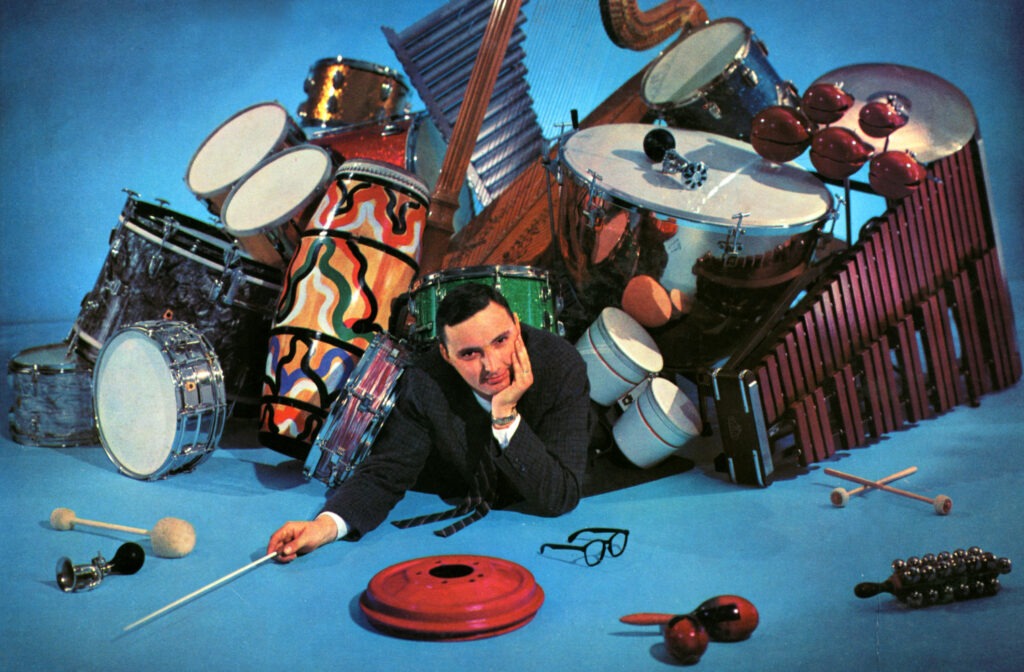
My long-time mentor Dick Schory (of Percussion Pops Orchestra fame) would tell me that he and his colleagues Bobby Christian, Thomas L. Davis, Tom Brown, and others “were very serious about what we were doing; we just didn’t take ourselves too seriously.” They weren’t afraid to be funny—even silly by modern standards. They could lean into the humor because the musicianship and artistry would speak for itself. It was a given, but it may also have worked against modern percussionists.
Photo shoot from the album Music for Bang, Barooom, and Harp by Dick Schory and the Percussion Pops Orchestra. Schory under a ponderous pile of percussion.
You might think “the percussionist doth protest too much,” but I for one have experienced real discrimination because I was assumed to be just a “dumb drummer.” I’ve known extremely qualified people who have been denied promotions to certain types of positions simply because of such implicit biases.
This type of discrimination has caused people in certain academic positions to forget that they are still drummers at heart. They know deep down they love hitting stuff to make music but wouldn’t dare bring it up at a dinner party at the president’s house. They feel compelled to renounce their heritage—a history that is steeped in the traditions of Vaudeville, Spike Jones, The Percussion Pops Orchestra, PDQ Bach, the Blue Men Group, and many others. What did they all have in common? They possessed a keen sense of comedy, they were accomplished musicians, and they were quite serious about their work.
After I entered the ranks of higher education in 1985 and then as I continued my education as a doctoral student in Percussion Performance in the 1990s, I began to figure out why percussionists were slowly losing their sense of humor. It was time to get “serious.”
As a DMA candidate I was responsible to know everything about the art, craft, history, and lore of percussion but also, everything about classical music writ large including the music of Bach, Beethoven, and The Boys, how many pedals there are on a harp, and other musical minutiae.
It is reasonable to expect that an educated musician would know about music broadly speaking but if you were a violinist much of music history is YOUR history. Was everyone expected to also know the history and development of the marimba, steel pan, or drumset? Probably not.
It occurred to me that percussionists seemed to be held to a different standard, but I was OK with that because I had already developed an intellectual curiosity about music, art, history, languages, culture, and much more. This curiosity fueled my desire to learn for the rest of my life. It also informed my teaching, performing, and mentoring to this day.
It took longer to nearly kill my sense of humor; it was a close call.
It took longer to nearly kill my sense of humor, but it was a close call. Having fun with my colleague Jean Francois Charles on clarinets on a Dick Schory classic, Baby Bossa Nova.
Along the way I began to notice that many percussionists share the same passion for erudition as me and it became clear that—hey! — drummers are smart!
Here are some examples:
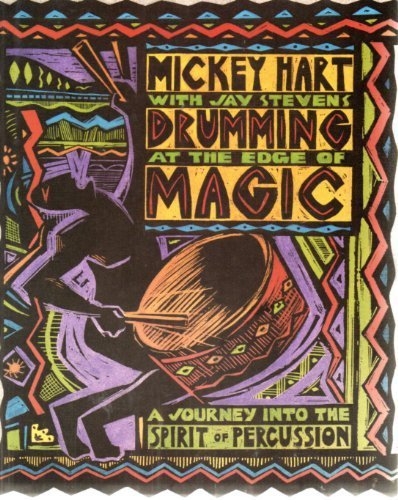
Drumming at the Edge of Magic, Mickey Hart
My first exposure to a drummer/scholar was reading Mickey Hart’s books Drumming at the Edge of Magic, Planet Drum, Spirit of Sound, and Songcatchers. Hart was one of the drummers for the grandfathers of the Jam Band movement, the Grateful Dead. He was a rock star who wanted to learn about the history of percussion, the stories, the legends, and the myths. He pursued this knowledge passionately, like a Bonafide Music Scholar. He collected stories and posted them on an enormous timeline of 3” by 5” cards nicknamed “the Anaconda” that encircled the walls inside his barn/studio on his Novato, California ranch. The Anaconda turned into the four books mentioned above.
My friend and duo partner of many years, Mat Britain, and I were inspired to collect quotes about percussion, music, and life as a result of reading Hart’s books. We still collect and share quotes and stories like baseball cards.
Gary Burton quote, oil on canvas by Alexis Alduenda.
Drummers such as David Garibaldi, Steve Smith, and others dug deep into the vocabulary of drummers of the past to develop their own unique voice. Their work was intellectual, thorough, and inspired, and as a result of their efforts, they developed a completely new lexicon of drumming simply by looking back, doing the research and analysis.
In the contemporary percussion world, there is Steven Schick who I met in 2000. He was an alumnus of the University of Iowa where I had recently become the second percussion professor in the history of the school and the successor of his teacher Thomas L. Davis.
Simply put, Schick was an enigma! A polyglot who was the most eloquent and intelligent thinker I had ever met, but like me, he was a drummer, a strange traveler in a hostile land.
But few musicians of any stripe have attained the level of influence on the musical world than that of Steven Schick. He set himself apart early on as the creator of an entire genre of musical performance—one of his own design. Dumb drummer—I think not.
The Percussionist’s Art, Steven Schick
He shared his artistic philosophy in his seminal book The Percussionist’s Art: Same Bed, Different Dreams, which has become a standard text for composers, percussionists, and lovers of new music. In his review of the book, composer Steve Reich wrote: “Just Imagine, as Steven Schick points out, you (the percussionist) and your friend (the cellist) are walking along. She with her extremely expensive and tradition-hallowed cello, and you’re on the way to the junkyard to pick out the most clangorous brake drum you can find and from there to garden supplies to find really nice-sounding flowerpots.”
There’s that self-deprecating humor again, but don’t let it fool you!
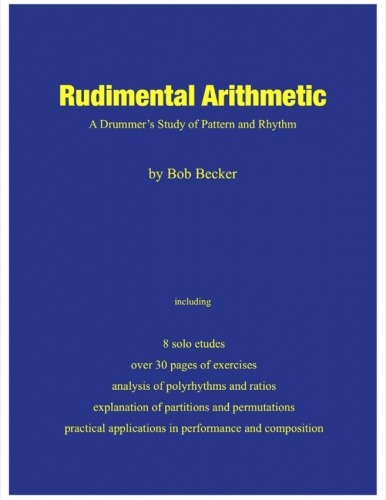
Throughout my professional career, I’ve enjoyed many great opportunities to share ideas, meals, and (more than a few) drinks with some of the most brilliant minds in percussion. I’ve argued well into the wee-small-hours with percussion scholars such as Bob Becker (whose amazing book, Rudimental Arithmetic, I helped to edit), on topics from the arcane corners of rudimental drumming to the fringes of contemporary music.
These were stimulating, Illuminating, and edifying conversations that helped to shape my thinking about percussion as a noun (the art of), a verb (to percuss), an adjective (percussive) or an adverb (to strike percussively). These conversations clearly transcended anything remotely relating to “how many drummers it might take to screw in a light bulb.” *
I’m not saying that these conversations were devoid of humor. Far from it because percussionists can move easily from the sublime to the ridiculous, but we are just more guarded these days about who we allow to hear it.
The younger generation also holds great potential. One example among many is Professor Michael Compitello of Arizona State University. His writing is incredibly thoughtful and thought provoking. We’ve struck up a friendship based on our shared love of all things percussive (adjective: relating to or produced by percussion). His upcoming book will be a deep dive into several important topics, and I look forward to reading and responding more to the early drafts of his work. I wonder if he knows any drummer jokes…?
In the early 2000s, I discovered that by becoming one of the few tenured professors of percussion at a Research-One (R1) Institution who also held a completed doctorate in music that I would begin to be called upon to serve as an outside reviewer of other percussion faculty.
In twenty-plus years I have completed evaluations of over forty percussion professors at major universities across the country. What have I learned? Quite a lot actually. I often find that most percussion professors are overworked, misunderstood, and (to quote Shakespeare for a third time) “altogether misprized.”
This is because otherwise musically educated people don’t seem to know what goes into making music on percussion instruments. For this reason, I call what we do as percussionists “Attempting the Absurd.” Imagine making beautiful and compelling music on a pile of wooden or metal slats with yarn covered balls on sticks. That about sums it up for me. Read more about that here:
It is amazing how often a musician will begin a conversation with me by saying “I don’t know anything about percussion.” My response is almost always the same; “you know about music, right? You should judge us on the same criteria as you would any musician.”
The majority of those I have reviewed are producing robust levels of creative and scholarly work—recordings, videos, books, commissions, blogs, lectures, or podcasts. For the most part, they speak and write eloquently about their work as musicians who play percussion, and they teach everything from percussion studio to marching band, new music ensembles, jazz courses, world music, history of rock ‘n roll, and much more.
It is encouraging, however, that many of the drummers/percussionists I know still enjoy a good joke and have not lost their sense of humor entirely—yet. I hope that never happens but as Bob Dylan would say, “The Times They Are a-Changin’.”
So, if you hear us make a self-deprecating drummer joke, don’t be confused. There is method behind the madness; a rich history mixed with quite a bit of intellectual rigor, discipline, creativity, wit, humility, and—yes—humor.
My experience is that many of the smartest people I know are some combination of writers, thinkers, humorists, scholars, poets, artists, comedians, and, as it happens, drummers.
The conclusion? Well, you know it already. Drummers are funny and smart, and the world is better for it.
One more thing before we go. The fact is that being funny takes wit, intelligence, creativity, and timing. There is an ancient show-biz truism that says, “dying is easy, comedy is hard,” but that discussion will have to wait for another day.
*In case you were wondering, “it takes ten drummers to screw in a light bulb; one to do the job and nine more to say that Steve Gadd could do it better.”
The above cartoon was created by my good friend Steve Smeltzer, whose work has appeared in publications such as Sweetwater Music Calendars, The Wall Street Journal, Chicago Health Magazine, Reader’s Digest, Saturday Evening Post, Good Housekeeping, and Better Homes and Gardens. He is the author of a book titled Fort Wayne in a Nutshell: A Cartoon Retrospective. Steve is also a darn good drummer and teacher!
Citations:
Hart, Mickey. Drumming at the Edge of Magic: A Journey into the Spirit of Percussion, 1 January 1990, Harper San Francisco, ISBN 978-0062503749
Hart, Mickey. Planet Drum: A Celebration of Percussion and Rhythm, 1 January 1999, Harper Collins, ISBN 978-0062503978
Hart, Mickey. Spirit into Sound: The Magic of Music, 1 October 1999, Grateful Dead Books, ISBN 1888358238
Hart, Mickey. Kostyal, KM. Songcatchers: In Search of the World’s Music, 1 June 2003, National Geographic, ASIN B0002UVA5W
Schick, Steven. The Percussionist’s Art: Same Bed, Different Dreams, 15 May 2006, University of Rochester Press, ISBN 978-1580462143
Becker, Bob. Rudimental Arithmetic (A Drummer’s Study of Pattern and Rhythm), 17 September 2008, Keyboard Percussion Publications, ISBN 0982112661
Smeltzer, Steven. Fort Wayne in a Nutshell: A Cartoon Retrospective, 6 July 2024, ISBN 979-8332358968
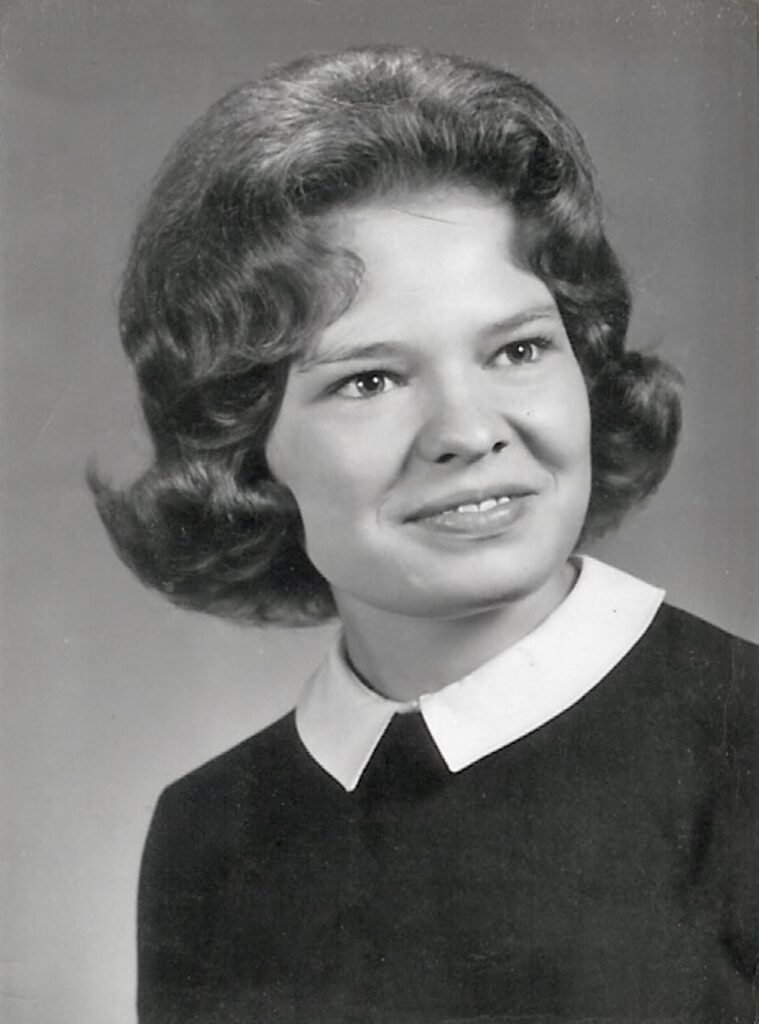
On March 10, 2022, the angels in heaven double-checked the tuning of their harps and reviewed their music fundamentals because Ms. DeeAnn Gorham was coming home.
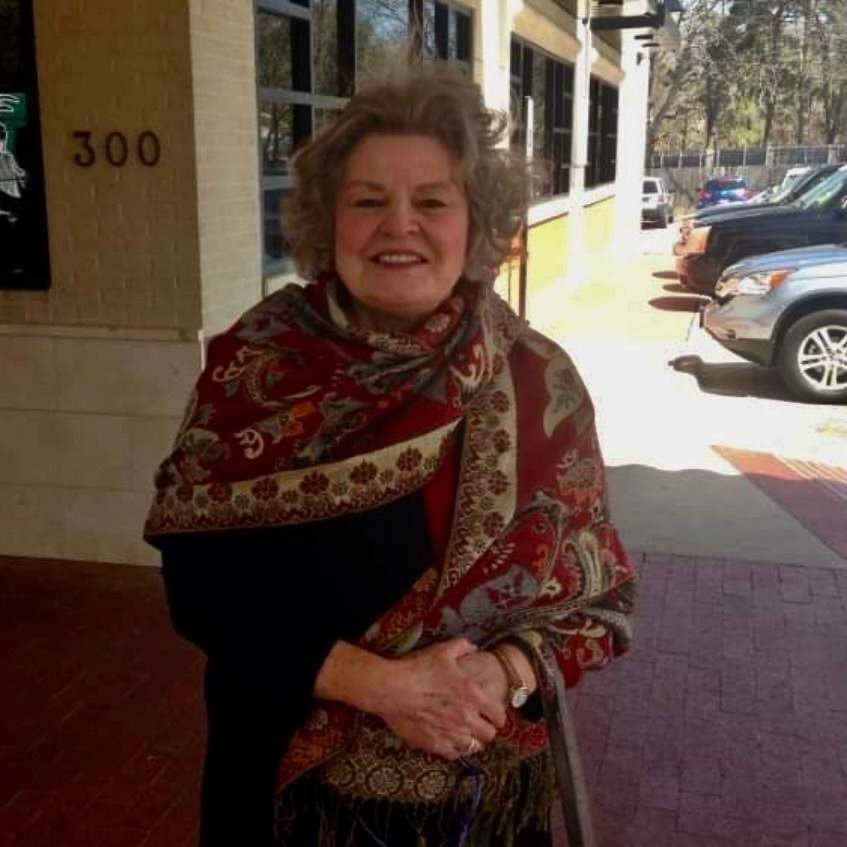
DeeAnn Logan Gorham (1946 – 2022) was a talented musician, an accomplished singer and pianist, who crash landed at East Texas State University in 1975 and continued to stir things up for the next 38 years
DeeAnn was “genuinely joyful, brilliant, intensely disciplined, keenly observant, serious, playful, and deeply loyal.”
Ms. Gorham was a diva; sophisticated, funny, and over the top but extremely no nonsense in her pursuit of being a respected university music professor. In her memorial service at Kavanaugh Methodist Church where she served as Music Director for many years, it was said that “DeeAnn was not only a musical virtuoso; she was also kindness incarnate; patient and loyal.” I and many others can attest to that fact that she was “genuinely joyful, brilliant, intensely disciplined, keenly observant, serious, playful, and deeply loyal.”
In college I was marginally funny and allegedly talented, but I was absolutely none of the other things that Ms. Gorham embodied. She was erudite, travelled, and most of all passionate about music. She, among many of my college professors inspired me to work harder and reach higher than I thought possible, or convenient.
One particular inspiration came in the unlikely form of Class Piano.
A harsh realization for many music majors is that in college one must take, and ultimately pass, piano class. I was a self-taught pianist who could play a pretty mean Smoke on the Water or the Theme from Shaft but otherwise I had no idea what I was doing when it came to real piano technique, sightreading, or music theory.
Unwittingly, Ms. Gorham became my class piano teacher. I suspect I was among her first students in piano class, which I had put off as long as possible. There was no more avoiding the inevitable. But taking her class turned out to be one of the most propitious curricular detours I had taken, because she was just what I needed at that point in my college career.
Among other precepts DeeAnn believed in the power of drill and discipline in the pursuit of musical excellence. I’ll give you an example.
“A proper diva would never arrive to a class on time.”
To begin, one must understand that a proper diva would never arrive to a class on time. She would rather glide into the piano lab promptly at eight-o-two every morning, her head erect as if balancing an invisible tiara on her head. She appeared with a load of books and papers in her arms, and an expectation that her pupils be seated and waiting. By the time she crossed the threshold, each student in the class was expected to have a page of note-book paper with lines numbered one to ten and their name and the day’s date printed legibly at the top.
As she casually organized herself—arranging books and papers on the desk and piano, she would call out different types of chords. Our task was to “spell” each chord (meaning the three or four individual notes that make up a particular chord) and scribble them down before she could say the next one.
“D-major” she would say with an upward lilt. “F-minor” she cooed somberly. “G-flat diminished seven” she purred in a subtle Mid-Atlantic accent. Each one delivered with a one or two second pause in between. It was the most stressful part of my day. Once she had given ten chords, we passed our sheets to the front of the class (curiously, she never checked the role because she now had a record of every person in attendance that day).
When we struggled, she would become frustrated and admonish us by blithely repeating “DeeFsharpA” in a rhythmic and lilting tone. “D-major is just DeeFsharpA” she’d say. “See, I can say it easily, DeeFsharpA” this time adding an operatic flourish of her hand. “It’s just DeeFsharpA.” And thus with a melodramatic sigh, class would begin. “Now, on to melodic minor scales in two-octaves please—ready and…”
This showed us that if we had to stop and give labored thought to the spelling of simple chords that the musical world would quickly move on with or without us. It was powerful. I still use this concept with my students today. It is a fundamental skill that many teachers overlook. Quickly knowing the parts of a chord is key to understanding tonal harmony and something every improvising musician must be able to do just to enter the playing field—much less the band stand.
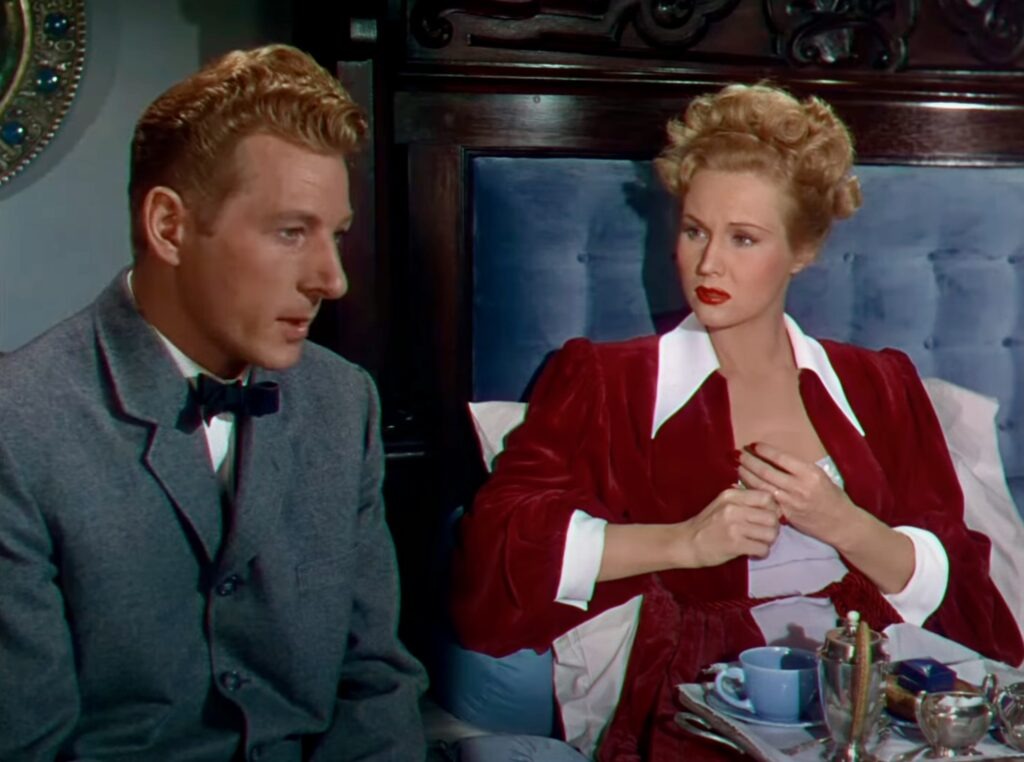
“… before I was three, I knew that the major chord on flattened supertonic was D flat, F and A flat; in the key of C, of course.” Danny Kaye knew the importance of good chord spelling in the pursuit of love. With Virginia Mayo in the film “A Song is Born.” Only musicians will get this…
I can point to many significant turning points in my life and career, but encountering Ms. Gorham was certainly one of the most influential to my teaching. There were of course many other pivotal moments of which I am completely unaware, but this is one that stands out clearly in my memory.
When I began to make a name for myself, many of my professors and classmates at ET were surprised, but not DeeAnn. She continued to cheer me on. With every visit I made to ET, she was always there to support me and tell me she was proud of what I had accomplished as a musician. I am so fortunate to have been given the opportunity to tell her how much I appreciated her efforts on my behalf on several occasions before she passed.
DeeAnn’s influence on East Texas State University is also clear as evidenced by their flying of the University flag at half-staff after her death and naming the Green Room in the new Music Building in her honor along with colleagues William Gorham and Charles Nelson. These are small but meaningful tokens of esteem from a school to which she had given so much.
Her ET colleague Gene Lockhart remembered DeeAnn as being “very patient but with great expectations; not just in piano or in theory or voice, but in everything she did.” Carolyn Lockhart recalled that “DeeAnn and I had a lot in common as we both taught children’s choirs in our churches, and we were both very strict. DeeAnn didn’t believe in having screaming kids running around; she expected them to behave and take their singing seriously and this made her program even stronger and larger than many other church-based children’s choirs.”
Her syllabus for voice lessons provides a glimpse into her philosophy for the disciplined study of music. “It is truly impossible to maintain and continue learning, growth, and singing more beautifully without continuity and perspicacity.” I’m sure most of her students (if they were smart) turned to the dictionary upon reading this line in the syllabus to find the following definitions. “Perspicacity: The ability to understand things quickly and make accurate judgments” and “continuity: uninterrupted connection, succession, or union.”
Is it as simple as spelling chords in piano class every day until one becomes fluent in the building blocks of music? You better believe it.
She followed with a few more of her favorite musical quotes, but the one that seems most prescient today is from Robert Shaw who said “…in a world of political, economic and personal disintegration, music is not a luxury but a necessity… not simply because it is ‘therapeutic’ but because it is the persistent focus of man’s intelligence, aspirations, and good-will.”
And finally, a warning. “I, of course, assume that you are here, seeking a degree, because you want to sing, you want to learn. Attending university is a gift, and therefore, you would always practice more than is sufficient for your own personal, vocal, musical, and spiritual growth; however, just in case you need external assistance: please do not make the faulty assumption that I do not know when you have avoided practicing.”
Of course she knew! She always knew.
“Continuity and perspicacity.” DeeAnn Gorham, a musical life well lived.
I believe her obituary said it best. “DeeAnn was an accompanist in life and music, breathing with the performer, anticipating need, and remaining fiercely focused on the exact support required. She adeptly and happily provided that support to the musician, the birds, the flowers, family, and friends. She was so fully present, as she made certain every movement was in support of the other person. And joyfully did so.”
Thank you DeeAnn for teaching us the lessons of continuity and perspicacity.
Oh, and another thing.
The Mid-Atlantic or Trans-Atlantic accent was often used by actors and announcers in classic Hollywood film and theatre productions of the early 20th Century for its perceived sophistication and clarity. It was taught in elite Northeastern private schools to create a “standard World English” for the educated elite.
“Erudite, travelled, and most of all passionate about music.”
Adam Rathe, Deputy Features Director for Town and Country Magazine writes that “throughout the Golden Age of Hollywood, stars including Katharine Hepburn, Cary Grant, Bette Davis, and Orson Welles employed what’s known as a ‘Mid-Atlantic accent,’ a sort of American-British hybrid of speaking that relies on tricks like dropping ‘R’ sounds and softening vowels, in order to convey wealth and sophistication on the silver screen.”
The implication is that the term “Mid-Atlantic” means that it was born somewhere in the middle of the Atlantic Ocean between The US and the UK where it is said that “Nobody lives.”
“Why, what ev-uh do you mean Daaling?”
Note: There may be more to say about finding yourself upwardly mobile by simply changing the sound of your voice in a future blog…
Citations:
1Rathe, Adam. What Is the Mid-Atlantic Accent: Why Katharine Hepburn and Cary Grant Sound like (Fake) Millionaires, Town and Country Magazine, Published 3 May 2020
2Widler, Billy. A Song is Born, film starring Danny Kaye, Virginia Mayo, Louis Armstrong, Benny Goodman, Tommy Dorsey, others, Samuel Goldwyn Studios, 19 October 1948
3Gorham, DeeAnn. Voice lessons Syllabus, East Texas A&M University, date unknown
4Definitions from Merriam Webster Online
5Lockhart, Gene & Carolyn. Telephone conversation with the author, 3 October 2025
With the start of a new school year a few days away, I begin to get excited about the prospects of the coming semester. In the academy, summer brings the opportunity to hit the reset button and by summer’s end, we should feel refreshed and ready to take on the challenges of another busy school year (You’ll notice I didn’t say rested).
As students return to the hallowed halls, I know that some are looking for a chance to redefine themselves, to develop new habits or break old ones or perhaps set some new goals. Maybe they hope to distance themselves from an unfortunate interaction (that most have already forgotten) or perhaps burnish their reputation as a dedicated student. Still others simply plan to take a few steps back in preparation for making some well-timed leaps forward.
All things are possible in the Fall. For me, Fall is a heady time that repeats every year and helps create the distinctive rhythm of my life. This rhythmic cycle is a tectonic movement that once felt slow and nearly imperceptible but now seems to gain speed with my every trip around the sun. Or as Jimmy Buffett puts it:
Every day’s a revolution Pull it together and it comes undone Just one more candle and a trip around the sun —Jimmy Buffett, Trip Around the Sun
In the metaphorical framework known as the “Four Seasons of Life,” Autumn is usually characterized as the second half of the life cycle but, In the Academy, Fall represents new beginnings. For many this could be a new year, new school, new job, new friends, new responsibilities, or new opportunities. So many things begin anew as golden summer turns to the orange and burnt umber of autumn, warm days, cool nights, and football under the lights.
Fall is ripe with opportunity! In our allegorical model Autumn can also represent a time of reflection, change, and transition, and depending on where you are in your educational journey (or life cycle) it may also involve some introspection about what your life might look like after the boys of summer have gone.
But as the semester approaches, I also begin to wonder what my students expect from their college experience. I ask myself “what do they want and how bad do they want it?” I know this because for most of my life I have struggled with the same queries. Identifying the “what” was never the problem, but it was the fundamental question that every person who aspires to something more in this life must ask themselves; “how bad do you want it?” In many cases the answer is, as singer and songwriter Don Henley would say, “not bad enough.”
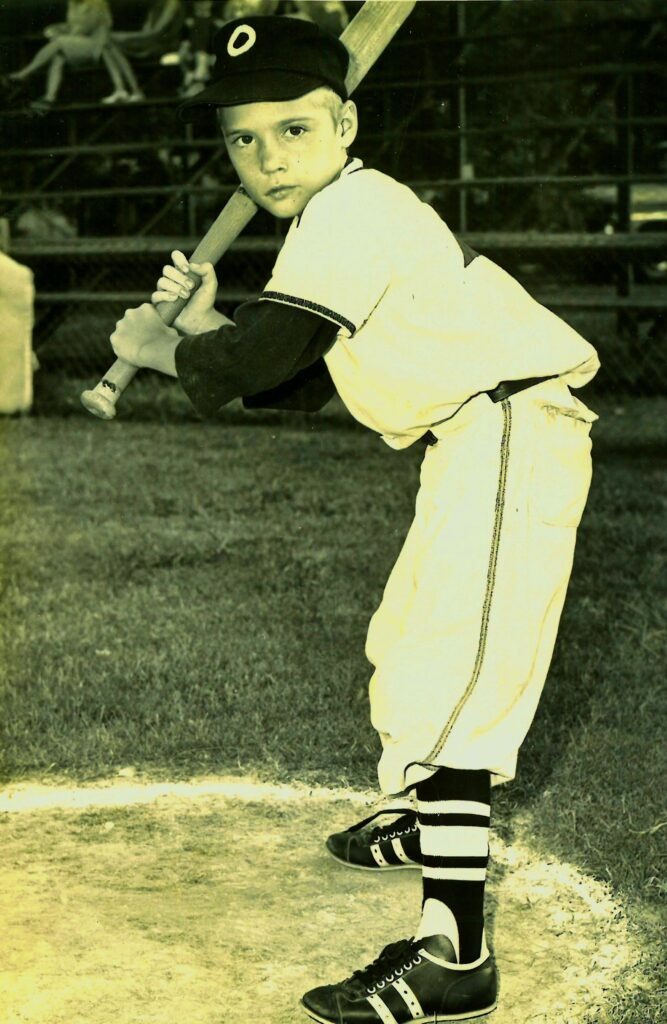
So you wanna be a big baseball player?
As a kid growing up in East Texas, I wanted to play baseball but, not bad enough. I wanted to play football but, again, not bad enough. I wanted to be an Architect but not bad enough to put in the work to get good grades.
Then I joined the band. There I wanted badly to play the trumpet but no matter how hard I tried, it wasn’t going to happen. So, in 1969 I landed in the drum section. How bad did I want that? Not at all…
But in the Fall of 1970, and because of a loving and masterful band teacher, I got to start over. And in doing so I began to feel the early pangs of desire to become a musician; a real drummer. I had never experienced wanting something so much that it gave me an ache in the pit of my stomach thinking about it. Whenever I failed to measure up to that teacher’s expectations, it physically hurt. In retrospect, and in my own experience as a teacher, I suspect that it hurt him as much as it hurt me. I’ve had that stomachache ever since and it hasn’t subsided. I hope it never does.
I’ll admit that from time to time, I’ve felt alone in my journey but as I kept at it, I met more and more kindred spirits along the way. The first one was my childhood friend who had a four-track reel-to-reel tape recorder that lit the fire of my desire to write and record music. Then it was my fellow high school band geeks who wanted to put together a horn band to play the music of the popular group Chicago.
My high school bandmate and future college roommate, Lynn Childers, and I stayed long hours after school in the band hall transcribing and arranging their music and arguing about if we got it right or not. On Saturday nights we cruised around our hometown blasting music out of the windows of his Ford Mustang just like all the other kids except we were listening to Frank Zappa, Bill Chase, Buddy Rich, Mike Oldfield, Blood, Sweat, and Tears, and of course Chicago. We made music together because we wanted so badly to do it.
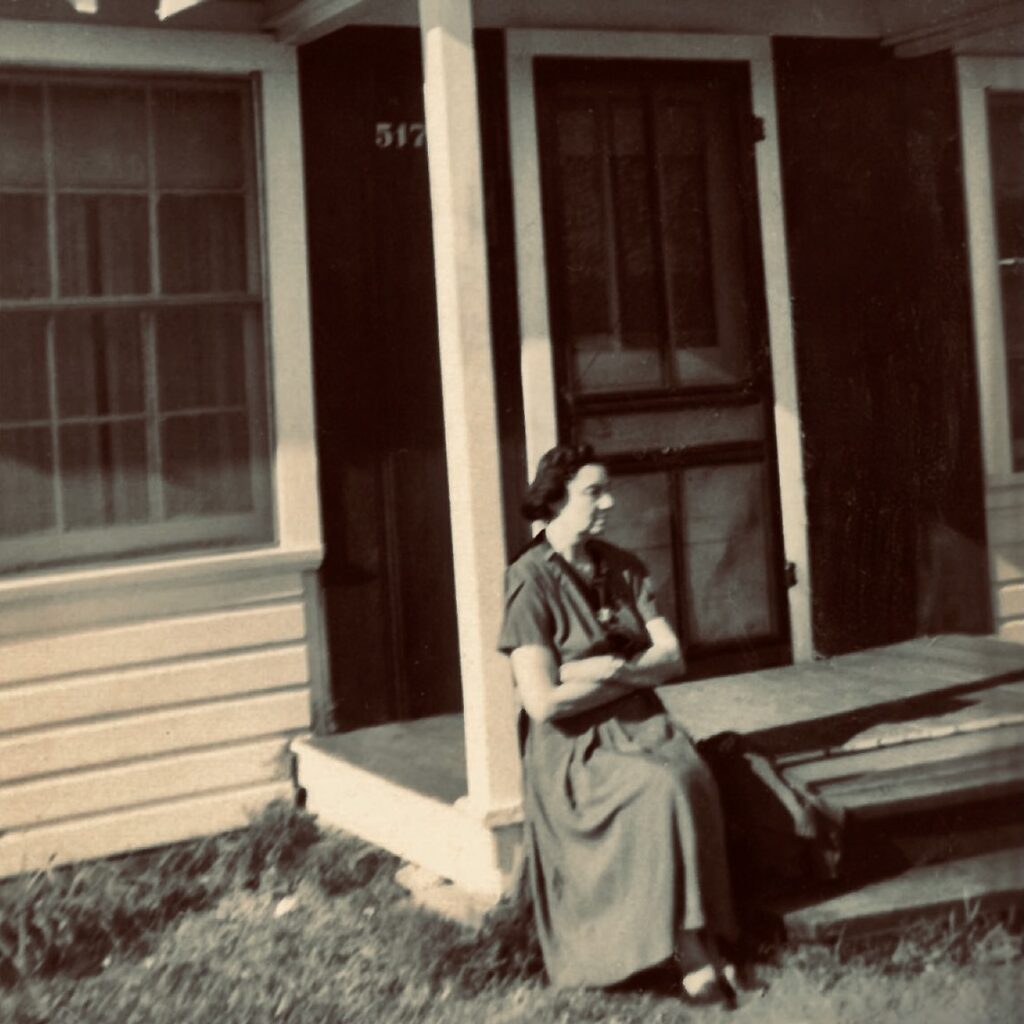
My grandmother knew all too well that wishes wouldn’t fulfill dreams. At home in Longview circa. 1950.
Whenever I got a new passion, something that I “really wanted” to do, my grandmother would say to me “wish in one hand and spit in the other and see which gets filled first.” Like so many East Texas syllogisms, it took me years to figure out what she meant.
Having survived the great depression as a young woman starting a family, my grandmother knew all too well that wishes wouldn’t fulfill dreams. She believed that the ability to achieve your goals only comes through action, dedication, and hard work.
I think she saw me struggling with the bellyaches of wanting to be a musician, but she worried that I didn’t have a strong enough work ethic to follow through on meeting that goal. By the time I figured out what she was trying to tell me, and I had begun to take her advice, she had passed away.
“Wish in one hand and spit in the other and see which gets filled first.” —Pattye Burgess Leverett
With Jimmy Yancey, the man who lit my fire. Back stage after a concert as guest soloist with the East Texas Symphonic Band, 2016.
Years later that same band director who lit my fire when I was 12 years old, told me that of all his students, I was the one that wanted to be a musician so much that I wouldn’t let adversity (meaning a lack of innate talent) or circumstances (coming from a poor family), prevent me from achieving my goal. He knew how badly I wanted it, even before I did. It was he who gave me the encouragement, the drive, and the push that my grandmother knew I needed. Thanks Grandma and Mr. Yancey.
A musician is all I can ever remember wanting to be. Longview Symphony rehearsal circa. 1975.
Since Junior High School, a musician is all I can remember wanting to be which is why I sometimes become frustrated with my students when they don’t appear to show the same drive and motivation that it took for me to get to where I am today. As a teacher, I have been surprised many times by how often students appeared to not—in my opinion—want it bad enough.
I’ve had students who loved being in band in high school, so they decided to continue studying music in college only to drop out the moment they hit a brick wall in theory class, or when they faced the inevitable scenario of practicing for hours and hours and not improving. Then, when their archrival—the one who never practices—makes first chair, it knocks the wind completely out of their sails. “It’s not fun anymore” is the reason most often given for dropping out. But again, it raises the question “how bad do you want it?”
American singer and frontman for the rock band Counting Crows, Adam Duritz, explains it like this.
“You’ve heard people say this a million times. They’re doing something they really like and then it gets hard and they’re like ‘it isn’t fun anymore.’ That’s the line that divides artists from people with hobbies because hobbies are fun—and they should be. Art can be enjoyable, but it’s not supposed to be [fun], and that’s not the deal. That’s not what it’s about. I mean it’s great if it’s fun but it’s not going to be fun all the time. And it’s hard and it should be hard and you’re gonna be miserable and hate it at times or just hate the experience—not the thing—because its real; it’s your whole life and that’s different.”
That’s the line that divides artists from people with hobbies because hobbies are fun—and they should be. Art can be enjoyable, but it’s not supposed to be [fun], and that’s not the deal. —Adam Duritz, Counting Crows
But is it possible to want something too much?
Yes, the cost of going “all in” on the pursuit of your goals can be quite high. It can affect your mental and physical health and your personal life. In the film The Devil Wears Prada, Nigel (Stanley Tucci) wipes his brow as he tells Andrea (Anne Hathaway) “let me know when your whole life goes up in smoke. Means it’s time for a promotion.” Nigel’s cynical view is that seeking career advancement can bring personal hardships if you are willing to sacrifice everything else in your life for work as he has done. It is important to keep in mind that when desire becomes an obsession it can create a vicious cycle where the very intensity required to achieve your goal pushes the desired outcome further away.
The reality, however, is that most people aren’t really at risk of over doing it in pursuing their goals which is probably why I’m not a professional baseball player today (among other reasons). Even the overachieving Italian Renaissance sculptor, painter, architect, poet, and writer of sonnets, Michelangelo, believed that “the greater danger for most of us lies not in setting our aim too high and falling short, but in setting our aim too low, and achieving our mark.”*
“The greater danger for most of us lies not in setting our aim too high and falling short, but in setting our aim too low, and achieving our mark.” —Michelangelo di Lodovico Buonarroti Simoni (1475-1564)
*Yes, I know that I have used that quote in a previous post but, hey, it’s a good one.
It’s all about balance.
There is a reason why as a culture we enjoy entertainments that require exceptional balance. Things like walking a tight rope, juggling, or spinning plates in the circus, the balance beam in gymnastics, or log rolling at the lumberjack competition are just a few examples. We respect and admire the skill needed to maintain balance because without good balance there is the inherent danger of failing—and falling.
The secret of maintaining a good work/life balance is to keep three areas of endeavor equally apportioned. These are the things we have to do, the things we need to do, and the things we want to do.
The things we have to do include those that are necessary to sustain life such as eating, sleeping, seeing a doctor, or simply stopping occasionally to “sharpen the saw.” Habit #7 of Stephen Covey’s Seven Habits of Highly Effective People is the concept of sharpening the saw. According to Covey “this habit is called Sharpen the Saw because dull or rusty tools are much less effective than clean and sharp tools.” Taking time to stop working and care for your tools will make things easier when you start again. The same applies for taking a break from practicing in order to let your mind and body (your tools) recover.
The things we need to do are those that we are required to do because of our responsibilities to others such as homework and attending classes, jobs to help pay the bills, or even mundane tasks like shopping for groceries which also impacts the things we have to do. For a musician, this might mean practicing for an ensemble you really don’t enjoy but is a requirement for your degree.
The final piece to be balanced is in the things we want to do. This is where your passion, your art, your calling lives. It is also the part that can knock your work/life balance completely out of whack! If we are passionate about something we are tempted to try and steal time from the things we have to do or need to do in order to focus on what we want to do.
I think every person who has pursued their passion has tried to cheat the balance at times and often with great success. This is an acceptable—even necessary—practice but, again, there is a cost. For anyone passionate about their life’s work, that cost is sometimes unavoidable because eventually the two neglected areas will demand equal time.
Here is an example the late pianist and composer Chick Corea gave about his creative process. “When I compose for a record, I work 18-20 hours a day, I eat and sleep very little, and I feel fantastically good! I have my businesspeople leave, and I don’t take phone calls or have visitors. I isolate myself and get that creative flow going. Once it starts, it’s like a snowball…”
In doing this, Chick was stealing time from the other areas of his life to focus on creating his art. Both in his life and in his music, Corea made good use of the musical concept known as tempo rubato. The term comes from the Italian word “rubare” which means to steal. In music this means stealing time from some measures making them shorter or adding time to others making them longer to facilitate a more expressive performance. The point is that time (in music and in life) doesn’t budge so, if you steal time from one measure (or part of your life) it must eventually be repaid. Is this a bad thing? Not necessarily. Just reread two paragraphs above one more time.
Don Henley puts this all in perspective for us but, I think you are getting the idea:
So, you put a hold on happiness A day, a week, a year You got to bring somethin’ to this party, boy If you party here
If you’re lookin’ for love I have to ask you
How bad do you want it? Not bad enough…
So, as Fall brings you new opportunities, try to keep your work/life in balance and keep asking yourself “how bad do I want it?”
Oh, and don’t actually spit into your hand; that’s disgusting.
Citations:
Buffett, Jimmy. Trip Around the Sun from the album License to Chill (2004), Mailboat Records, August 16, 2004
Beato, Rick. Counting Crows: Adam Duritz Interview, accessed August 21, 2025
Corea, Armando “Chick”. Interview on writing the Mad Hatter album, Downbeat Magazine, March 1978
Devil Wears Prada. Film directed by David Frankel and produced by Wendy Finerman, screenplay, written by Aline Brosh McKenna, based on the 2003 novel by Lauren Weisberger, the film stars Meryl Streep, Anne Hathaway, Stanley Tucci, and Emily Blunt, 2006
“The moon is full, and there is not a cloud in the sky. No stars are visible because of the deep white glow of the moonlight on the snow, which triples the ambient light and makes it possible to drive without headlights on these back roads. . ..” —Hunter S. Thompson, Generation of Swine “The Dim and Dirty Road”1
Composer, banjo player, folksy philosopher, and my dear friend Paul Iserman Elwood died February 2, 2025, after a year-long battle with glioblastoma, an incurable form of brain cancer. He had survived other attacks to his body over the years, but it was the assault on his creative and deeply contemplative brain that would be his undoing.
Paul loved to improvise and spent much of his life in that pursuit. As a composer (described as improvising in slow motion) and an improviser (composing in real time) it is not surprising that he found a musical metaphor in Thompson’s words.
Paul rehearsing for a Strange Angels concert in Taos, New Mexico (2012).
I met Paul in 1984, not long after arriving in Kansas for Grad School at Wichita State University. He was the craziest, goofiest, banjo-playing-avant-garde composer I had ever encountered (if you don’t count Edwin London in the 1970s who I don’t believe played the banjo). We were kindred spirits—equal parts musical misfits, ducks out of water, and chronic sufferers of imposter syndrome. We were both 26 years old—born in 1958—and searching for our place in the musical world. We became instant friends.
I came to Wichita State as a marching band Teaching Assistant thanks to my work as a drum instructor for the Sky Ryders Drum and Bugle Corps of Hutchinson, Kansas, just over 50 miles from Wichita, so my reputation somewhat preceded me. Percussionists at WSU, however, were unimpressed. Walking into the percussion studio for the first time, I was greeted by a message scrawled on a chalk board in large letters reading, “who is this Daniel Moore guy anyway?” My first thought was “Toto, I’ve a feeling we’re not in Kansas anymore,” which seemed appropriate except for the fact that I WAS in Kansas, but you get the idea.
What I found at WSU was an incredibly creative place thanks to inspired musical mentors like professors J.C. Combs and Walter Mays, as well as a group of talented classmates many of whom would become shining stars in the musical firmament and have remained my friends to this day. There was so much creative energy at WSU that if you had a new composition, you could walk from one end of the music building to the other and before reaching the back door you could assemble a group of outstanding musicians ready to play your new piece—whatever it was.
Paul took advantage of this moment in time and as luck (and I mean that sincerely) would have it, Paul scooped me up in his net to play his newest composition Snow Falls Ceaselessly (1984) for flute, cello, keyboards, and percussion with dancers, a hand signer and audience players. It was like nothing I had ever been involved with in my life, and I loved it. Saying “yes” when Paul walked by on that Fall day changed my life.
As an undergrad, Paul studied composition with Walter Mays (1941-2022), a Pulitzer Prize nominated composer and prominent teacher who was a significant influence on his development as a composer. Then he was propelled further into the avant-garde after a week of interaction with legendary composer/philosopher John Cage. In an interview Paul said that “He [Cage] gave lectures, he did rehearsals. Monday morning, I was in the first piece that he rehearsed, it was for three conch shell players with shells filled with water that we moved around and every now and then a bubble would surface and could be picked up by a mic. That was the piece, it was called ‘Inlets.’” 2
“Inlets” rehearsal with John Cage.
As I got to know Paul, I learned that he had a multifarious life; one as an avant-garde composer, another as a performing percussionist, another as a music teacher of children, and still another as an excellent banjo player and Bluegrass musician. Paul had already won the title of Kansas State Bluegrass Banjo Champion before heading off to Texas to study composition with influential composer Donald Erb at SMU. But it was this dichotomy that troubled him for many years as he navigated the choppy (read: snobby) waters of a musical elite that valued conformity over creativity and the diversity of ideas.
Paul always saw himself as an outsider. In a 1985 interview he said, “I can’t seem to fit into any group at all.” Speaking of his alternative-acoustic-trio the Sons of Rayon he went on to say that “we consider ourselves nerds… we’re outcasts from the bluegrass crowd and outcasts from new wave. We’re not hip.” The interviewer, however, took issue with that characterization saying that “some might disagree. Their appearances draw a regular crowd, and they have a mailing list of about 200 people. …their music is the revenge of the nerds.”3 But they were hip; they just didn’t know it. More about the revenge of the nerds in a minute.
It would be years before Paul would come to terms with his life as both a serious composer and oddball musician. Perhaps it was finding confidence in himself with the help of the love of his life Régine Esposito. I like to think so.
Paul and Régine, Wichita (2007)
It was a joy to be able to witness his evolution from disenchanted outsider to confident artist. I wrote a letter of reference for Paul for the John Simon Guggenheim Memorial Foundation Award every year from 2007 to 2023 and every year he was turned down. It was like one of the rhythms of my life; every December the phone would ring; it would be Paul wanting to catch up and asking me to write another Guggenheim letter. In 2023, he laughed and told me that, if nothing else, he hoped someday to hold the record for being turned down the most times. He never felt sorry for himself, even when he was sick. I think that is a far superior accomplishment.
Here is what I wrote in my 2023 letter of support for his last Guggenheim application:
“I have observed with great interest as Paul grew into his now mature musical voice as a composer. In many ways he is an outsider in contemporary music as a result of his refusal to be defined by current trends or the inherent conflicts between the life artistic and the career academic. Today I celebrate the resultant maturation of his singular compositional style and applaud his resolve to stay the course of his diverse artistic vision.”4
In 1984, it was perfectly preordained that Paul and I would meet when he returned to his hometown to teach music at Castle in the Air preschool and co-found the Wichita New Music Ensemble which (by the way) gave me my first non-school affiliated performance of one of my compositions. We were destined to meet and form a friendship that would last until his passing.
At WSU, our percussion teacher and mentor J.C. Combs was an imaginative impresario who despised much of the music written for percussion ensembles and he was open to new ideas for composition. In a recent interview J.C. said “I just wanted to do more creative things. I had been at WSU for about ten years, and I was bored with a lot of percussion music, so the projects sort of happened naturally as a way to keep myself and my students (and the audiences) interested in what we were doing. I also found that it was a great way to bring people in the community into the creative process.”5
Combs and Mays had already collaborated on a major work that featured an “extended percussion ensemble” and included jack hammers, bowed Styrofoam, four drumsets (with no cymbals) and Heavyweight Championship Wrestlers. Yes, you read that correctly—wrestlers. *
The Wichita State University Percussion Ensemble with guest drummers, Danny Gottlieb and Ed Soph at the 1983 Percussive Arts Society International Convention in Knoxville, TN. Left to Right; Ed Soph, Mike Harris, Bruce Chaffin, Jeff Gleason, Jim Lavin, J.C.Combs, Mat Britain, and Danny Gottlieb. Just out of sight Carole Daubert, Dan Moore, and others. (photo courtesy Percussive Arts Society)
Advertisement for the Premiere of War Games in 1982 (Courtesy of J.C. Combs)
So, the stage was set at Wichita for Paul to step in with his own brand of outlandish works for percussion ensemble that J.C. and his students took on with (occasionally guarded) enthusiasm. Dr. Combs once said that “creative things aren’t always without risk”6 and he, of all people, would know about risk. In a 1984 article for the Wichita Eagle-Beacon, arts columnist Don Grainger wrote that “it was the same J.C. Combs who starred in a locally produced motion picture about the decline and degradation of a music professor fatally addicted to pinball machines. The opus ended with an impressive bang when the student assigned to arrange a small explosion to indicate the end of the film overloaded the charge by a factor of (at least) three.”7
Paul’s music was certainly full of risks and I for one was ready to take them on. During my two-year tenure at WSU the percussion ensemble performed Under the Evening Moon for string quartet and percussion ensemble featuring folk musician, clogger/banjo player, Beverly Cotton; and Edgard Varese in the Gobi Desert for percussion ensemble and Velcro Tap Dancer Kelly Werts. Between 1983 and 1984 Edgard Varese in the Gobi Desert was performed at SMU under the direction of Deborah Mashburn, at WSU under J.C. Combs, and at Ithaca College under Gordon Stout. It was his first major composition, and a fascinating work that has been performed many times throughout the country.
In an extraordinary burst of creative energy over an 18-month period, Paul wrote many new works for the WSU Percussion Ensemble, The Wichita New Music Ensemble, and for percussion degree recitals for his friends and classmates. During that time, Paul composed the afore mentioned Snow Falls Ceaselessly, Under the Evening Moon, and Edgard Varese in the Gobi Desert, as wells as Birds of Appetite for string quartet, Upon Waking in the Rear Arbor for brass quintet and solo percussion (for Gary Gibson and conducted by yours truly) Verbum Salutis for flute, bass clarinet, cello, percussion, and hand signer (for my Master’s Recital) and Roy Rogers Meets the Zydeco Kid, a radio drama starring Jack Pie Johnson (for percussion soloist Bruce Chaffin and three narrators). I am particularly fond of this piece as “Jack Pie Johnson Boy Composer” was Paul’s nickname and alter ego. The middle name “P.I.E.” of course stood for Paul Iserman Elwood.
Final Graduate Percussion Recital in 1985 featuring a new work by Paul Elwood.
I thought Paul was the coolest cat I had ever met, and I glommed on to him as quickly as I could. Even back then, I imagined myself becoming the prime interpreter of his work. He wasn’t sure he needed (or wanted) one at the time, but I was interested in—and fought for—the position none-the-less. I also fell in love with his self-described “Nerd-grass band” the Sons of Rayon.
Early Sons of Rayon promo pic; Karen Boggs, Kelly Werts, and Paul Elwood. (Photo courtesy ofMadelineMcCullough)
In their promotional material The Sons of Rayon claimed to hold “the dubious honor of having re-invented the string band, with an eye toward the needs of a twentieth century audience. The three sons (one of which is a woman) experiment persistently with non-traditional ways of combining the traditional sounds of their acoustic instruments. With three-part vocals recalling the ‘high and lonesome sound’ of old-time singing, their modern original arrangements retain a classic balance of old and new.” They go on to say that “the group also reflects the more recent innovations of the psychedelic Sixties on through to New Wave of the Eighties. …Add to that, flavors from India, Africa, Ireland, and Mexico, and you have a truly eclectic ensemble.”8 In my opinion, this doesn’t even begin to describe the Sons. I was besotted every time I heard them perform.
The Sons of Rayon; Kelly Werts, Karen Boggs, and Paul Elwood circa 1984.
I have a cassette tape of the band that I’ve cherished for my entire adult life. One of my favorite Sons tunes was UFOs over New Zealand. The melody and lyrics stuck with me for more than 30-years until Paul finally agreed to let me do a cover of it with him singing. The concept of the song is perplexing; it muses about cowboys in outer space, Unidentified Flying Objects over New Zealand, and spaceships known to South African Zulus from the KwaZulu-Natal province. It was a Nerd-grass lover’s dream and would be the closest I would ever come to being one of the Sons of Rayon.
Sons of Rayon—No Velcro cassette tape, 1986, including UFOs Over New Zealand.
Paul and I worked on an arrangement of UFOs in 2007 as a proof-of-concept test for what would become our 2013 album Does Anybody Really Know What Time it is? (innova 864). That record was created by a musical collective under the sobriquet “Misfit Toys.” The band featured Paul on banjo and vocals, Matthew Wilson on drums and vocals, the late clarinet master, Robert Parades, on clarinet and vocals, some amazing guest performers, and me on everything else.
Unfortunately, the track didn’t make the cut as we pivoted the project to a collection of reimagined tunes from the 1970s. It wasn’t until 2017 that we revisited UFOs for a performance of Paul’s Strange Angels project in Iowa City. The track then went back into digital purgatory on a hard drive until I pulled it out again after his passing. The sound of his unique voice was solid, mature, and optimistic; his pitch is crystal clear and unaided by autotune. It gets me every time.
The Measure of Friendship
In remembering Paul over the last few weeks, I thought about the measure of a friendship. One measure might be someone who will compose a new centerpiece for every important moment of your career. Paul wrote music for so many events in my life including my Master’s recital (Verbum Salutis), a DMA recital (Prelude to the Blue and Perfumed Abyss), and many other important performances. He never wanted a dime for his commissions from me. He would say “just get me six performances” with which I dutifully obliged. I’ve performed his works at four universities, at the Percussive Arts Society International Convention, on new music concerts, and in venues from Kansas to Montana, Kentucky to Colorado, and North Carolina to New Mexico, not to mention more than a few performances at the University of Iowa.
Having a friend who will respond with an instant “yes, and” every time you utter the phrase, “here’s a crazy idea” is a blessing. Paul and I said “yes and” to each other for over forty years. Even in the last months of his life we continued talking about the “next” project. Paul was friends with a relative of one of the Brothers Gibb (you may know them as the BeeGees) who liked our Misfit Toys project and was interested in doing a “Misfit Toys plays the BeeGees” album with us. We talked about it again in the summer before he died. He still had plans to return to the University of Northern Colorado to teach his students and I suggested we start sharing demos for the BeeGees project while he was convalescing. He said he would try but was starting to “get kind of foggy.” I told him to do his best and that I loved him. It was the last time we spoke.
Paul was a great friend, and he visited us in every place Liesa and I lived since the day we met in Wichita. He would come, play the banjo, cook egg rolls, and even sleep on the floor amongst boxes in a bedroom not yet unpacked from a move to Lexington, KY. He travelled to Bozeman, MT with his lifelong friend Kelly Werts to perform his most famous work Edgard Varese in the Gobi Desert with me for the second of several times in my career. And he came to Iowa frequently to play music, make recordings, and plot our overthrow of the musical elite.
We once had a fun evening in our little town when having dinner in a darkened restaurant, Paul was mistaken for the actor Billy Bob Thornton. He relished the idea of being mistaken for a celebrity and played the part with gusto all evening. Paul was unfazed saying that this sort of thing happened to him all the time during his “Billy Bob doppelganger days.”
He simply added these fantastic happenings to our many shared experiences and filed them away as another facet of his fascinating life as an itinerate musician/composer.
But Paul had many other friends and musical collaborators just like me, and I was always jealous! Not really jealous. . .but yeah, kinda jealous. He had dozens of collaborations with musicians from around the world, and he wrote pieces for them as well. His musical DNA can be found in the repertoire of many musicians and ensembles throughout the world, and I expect his music will continue to live on, that is, if we have anything to say about it.
It is apropos that one of the last bands he performed with was called Multifarious, a jazz trio with friends Sue McKenzie playing saxophones and Susan Mayo on cello, to put a final exclamation point on his truly multifarious musical life.
Riffing on Hunter S. Thompson in a blog post from 2016, Paul wrote that “Improvising is sometimes like driving without headlights on backroads on a moonlit night”9 which translated means that “improvising is exciting but not always without risk!” One thing we’ve learned is that creative things aren’t without risk, but Paul wouldn’t have had it any other way.
Paul Iserman Elwood, composer and musician of Wichita, Kansas, September 21, 1958 — February 2, 2025, Marseille, France. Rest in Peace my friend.
Paul circa 1985.
One more thing before we go:
Musa Yelcin writing for the idea sharing website Medium (a home for human stories and ideas) writes that the African Zulus “are a mysterious society that stands out not only for their warrior identity but also for their deep connection with space.” They call themselves “Children of the Sky” and believe that their origin is in the stars. The post goes on to say that “The modern scientific world is also interested in the Zulu tribe’s extraordinary astronomical knowledge. It’s no coincidence that NASA has studied Zulu astronomy, and some archaeologists believe the tribe possessed ancient technological knowledge.” There are many tribal stories of “visitors coming with metal birds” and cave drawings resembling spaceships frequently encountered in Zulu legends that have caught the attention of “ancient astronaut” theorists. “Tribe members see the sky as the ‘home of ancestors’ and perform special rituals during every full moon,” and they consider meteor showers to be sacred.10 Just thought you might like to know where those crazy lyrics for UFOs Over New Zealand sprang from.
Oh, and another thing:
Composer, conductor, and teacher Edwin London might as well have been talking about Paul when in an interview with Bruce Duffie he said “I have always assumed, both in my own work and my own career and with others, that each of us has an individual voice within, and that if the world were a more hospitable place, everyone would have an opportunity to define their own voice, or to at least hear it, so that everyone would understand each other. As it is, many people get shut out of the process, and the artist is usually a one-minded-type individual who comes to the fore in a cultural situation as a progenitor of art. Maybe that is what art is for—that somehow, those who are obsessive enough or obsessed enough to continue working, to break through the barriers of inhibition in terms of their own work and their offerings, get a playing. Maybe it’s as simple as all that. Maybe they are metabolically suited to being artists and others aren’t.”11
Amen!
Citations:
1Thompson, Hunter S. Gonzo Papers, Vol. 2: Generation of Swine: Tales of Shame and Degradation in the ’80s, Summit Books, 1988, ISBN 978-0-671-66147-2
2Beaudoin, Jedd. Composer Paul Elwood Maintains Sense Of Mystery With ‘Strange Angels’, Interview for KMUW 89.1 FM, Wichita, Kansas, March 15, 2017
3Earle, Joe. Celebrating a Synthetic Heritage, The Wichita Eagle-Beacon, Wednesday, November 20, 1985
4Moore, Daniel P. John Simon Guggenheim Memorial Foundation: Confidential Report on Candidate for Fellowship Paul Elwood, author’s personal papers, December 11, 2023
5Moore, Daniel P. Conversation with JC and Karen Combs, Wichita, Kansas, November 13, 2021
6Moore, Daniel P. J.C. Combs and the Wisdom of Words and Wrestlers, blog post June 6, 2021
7Grainger, Don. J.C. Combs Has Done It Again: Percussion Professor Stretches Limits with Pop(corn) Music, The Wichita Eagle-Beacon, Lively Arts, Sunday, April 15, 1984
8Contributor. Sons of Rayon Promotional Material circa 1984, from the author’s collection
9Elwood, Paul I. The Dim and Dirty Road, Sound Choices: Paul Elwood, blog post, January 1, 2016
10Yalcin, Musa. The Children of the Stars: The Mysterious Space Connections of the Zulu Tribe, Blog post, The Medium:
11Duffie, Bruce. Composer/Conductor Edwin London: A Conversation with Bruce Duffie, bruceduffie.com, 1989
Groundhog Day has come and gone, and I was tempted to write another blog post about one of my all-time favorite Bill Murray films, Groundhog Day, directed by Harold Ramos. But instead, I decided to begin a series of posts devoted to creativity. Why? Mostly because nobody read my last two posts about Groundhog Day and because the idea came to me in a moment of clarity.
Moments of clarity have many names. They can be “light bulb” moments for a great idea; a “breakthrough” when you finally solve a tricky problem; a “flash of inspiration” that reveals a new composition in its entirety and all at once. It could be an “epiphany” that changes the direction of your life or an “awakening” that leads to a deeper spiritual understanding. It could be as simple as an “Ah ha” moment when a concept that wasn’t understandable just a few seconds ago suddenly becomes clear.
Moments of absolute clarity are rare and exhilarating experiences, yet they can unfortunately, be interspersed amongst hours, days, or even years of complete and total cluelessness.
They are rare yes but somehow happening all the time. Huh? Trust me dear reader but remember “only idiots fail to contradict themselves three times a day.”—Friedrich Nietzsche
“Only idiots fail to contradict themselves three times a day.” —Friedrich Nietzsche
When these elusive moments deign to present themselves, you better be ready, be willing, and be able to act on them before they move on to the next recipient. That’s right, you are almost never the only beneficiary of a moment of creative inspiration.
A composer friend of mine once told me that he thought I must be spying on his idea notebook, because I kept beating him to the punch publishing pieces for which he had a similar idea. I told him not to worry because this has happened to me many times throughout my career.
I’ve had plenty of cool ideas but at the time lacked the ability, connections, time, or understanding of how bring them to life. Then, out of the blue, someone comes out with MY great idea! They received the same moment of clarity as me. The difference is they acted on it, and I couldn’t (or didn’t). Snooze you lose.
The great drummer Billy Cobham agreed that “there are musical gifts, but it might be the gift of an idea.” That about sums it up for me (to quote Groundhog Day).
One problem for me is that precious moments of clarity always seem to come when I am either trying to sleep, or on a fifteen-hour flight, or too busy to do anything about it. I fail to act on these spasms of lucidity for many different reasons including lack of time, energy, money, resources, or motivation. Previous commitments, exhaustion, simple laziness, or some combination of the above are why many of my (arguably) great ideas went unrealized.
Don’t get me wrong. I’m not complaining because I have often been blessed with being in the right place at the right time when inspiration strikes. It is great to be on the receiving end of a good idea; it is absolute torture to be unable to bring that idea to fruition.
As a musician, composer, and educator I am interested in these moments of clarity and by extension—discipline and ritual. Although these characteristics may seem at odds, I assure you that discipline and ritual are among the most important tools for recognizing and acting on moments of clarity.
Many believe that moments of creative inspiration come from external sources such as the Muses for example. The Muses were Greek goddesses who were said to inspire the arts, music, and poetry. There are many romantic accounts of artists and their muses. F. Scott Fitzgerald was famously inspired by Zelda; Shakespeare’s ubiquitous Rosalind appears in at least three of his plays; and George Harrison and Eric Clapton fought over Patti Boyd for years resulting in some pretty darn good music.
unknown artist; Copy of a Panel from the ‘Sarcophagus of the Muses’*; Senate House, University of London; http://www.artuk.org/artworks/copy-of-a-panel-from-the-sarcophagus-of-the-muses-248642
Some, on the other hand, don’t put much stock in the role of muses in their work. Writer Helen Hanson advises that “inspiration is the windfall from hard work and focus. Muses are too unreliable to keep on the payroll.”
Somerset Maugham had more faith in his own discipline and routine than in external influences. “I write only when inspiration strikes. Fortunately, it strikes every morning at nine o’clock sharp.” He prepared for inspiration by starting work each morning at the same time. If inspiration struck, he would be ready to receive it. But there is also an implication that Maugham believed he could “will” inspiration into existence simply by showing up to work on time. I think he was right.
Perhaps the biggest danger and the most grievous offense then is to have a moment of clarity on which you fail to act. Michelangelo said, “the greater danger for most of us lies not in setting our aim too high and falling short; but in setting our aim too low and achieving our mark.”
“The greater danger for most of us lies not in setting our aim too high and falling short; but in setting our aim too low and achieving our mark.”—Michelangelo
But what do you do in case an idea presents itself? Simple; prepare in advance.
Preparing to be creative, or to learn, or to practice, or to…
Ritual
Dancer, choreographer, writer, creative spirit, octogenarian, and my current hero Twyla Tharp opens her book The Creative Habit by saying “I begin each day of my life with a ritual: I wake up at 5:30 am, put on my workout clothes, my leg warmers, my sweatshirts, and my hat. I walk outside my Manhattan home, hail a taxi, and tell the driver to take me to the Pumping Iron Gym at 91st street and first avenue, where I work out for two hours. The ritual is not the stretching and weight training I put my body through each morning at the gym; the ritual is the cab. The moment I tell the driver where to go I have completed the ritual.”
Twyla Tharp Photo: Wall Street Journal
Of course, a ritual for a painter, writer, composer, or musician might be different but the important thing is to find YOUR ritual; the one that puts you in the proper frame of mind to receive a moment of clarity. You must have your receptors cycled on and waiting for such a moment to appear.
Tharp goes on to say; “It’s vital to establish some rituals—automatic but decisive patterns of behavior—at the beginning of the creative process, when you are most at peril of turning back, chickening out, giving up, or going the wrong way.”
A ritual can be as simple and mundane as making your bed each morning or having a pencil in your pocket.
Be Prepared
Twyla Tharp tells us that in his essay “Why Write” Paul Auster relates the story of meeting his childhood idol, baseball player Willie Mays and trying to get an autograph. After mustering the courage to break through the crowd for the autograph Mays asked; “Do you have a pencil?” He didn’t, and no one else did either, to which Mays replied, “no pencil, no autograph kid.” To this day Auster, a professional writer, ALWAYS carries a pencil. The moral of the story is that you must be prepared to do the work. You should ALWAYS have everything you need to do your best work ready and waiting. (paraphrased from The Creative Habit).
When creating something, you become a receptor of ideas. When I set out to compose or arrange a piece of music, I have a process to prepare myself to receive inspiration. When working on a new composition I regularly schedule time to “discover” new things by means of purposeful “messing around.” From there the ideas begin to dart around my brain playing a game of musical hide and seek. This goes on for an indeterminate gestational period until finally everything comes together fully (or near fully) formed — and (as mentioned above) typically in the middle of the night. But there are no guaranties.
There is an old story about a struggling comedian who keeps dreaming every night that he is telling the funniest joke ever written to an enraptured audience. The stuff that Nate Bargatze can only imagine. The problem is that when he awakes in the morning, he can’t remember the hilarious punchline that could make his career.
He complains to his comedian friends who advise him to put a recorder near his bed so that he can wake up and capture the joke without getting out of bed. The next morning, he notices that the recorder has been activated during the night and was excited to hear this game changing joke, but when playing back the recording, he only hears the incoherent mumbling of someone talking in their sleep. Clarity is a fickle friend but apparently not without a sense of humor.
But if you are in the right place at the right time, with your receptors on and, uhm, “recepting”, then all that remains is to transition those ideas from the metaphysical to the physical world in the appropriate format such as a recording, a computer file, or on an old-fashioned piece of paper or canvas.
So, what causes these fleeting moments, and better yet, how do we capture them when they happen? Learning to tune your receptors to the possibility of incoming messages is key. This can happen simply by making room in your mind and time in your day for them to break through. One thing is certain, moments of clarity come on their own schedule and although you probably can’t really force them to happen, you can at least let them know that you are ready whenever they are. (contradiction noted)
The only advice I can offer from my own experience is that when you get stuck, it can help to distract yourself by doing something that takes your mind off the problem. Get away from your project or assignment. Go to a concert, watch a great movie, read a book, go to a baseball game, or do a puzzle. Interact with any type of activity that is outside your area of interest or endeavor and watch people who are at the top of their game. The next time you begin your ritual of preparing your receptors, the door might open up just enough for your moment of clarity to walk through.
Keep in mind what 19th Century poet and writer Guillaume Apollinaire advised, that “now and then it’s good to pause in our pursuit of happiness and just be happy.”
“Now and then it’s good to pause in our pursuit of happiness and just be happy.”—Guillaume Apollinaire
Stay tuned for Thoughts On Creativity Part II which will be finished the next time I get a moment of clarity—but who knows when that might be…