The Rainbow Corps is Back: Return of the Sky Ryders
It’s DCI Finals week and I am reminded once again that when Drum Corps gets into your system it is hard to get it out. Every summer, it seems, I feel the pangs of youth when I begin to see the drumline lot videos popping up online. After all these years I still have vivid dreams that I’ve been called back into service as a drumline caption head looking for a quiet place to warm up the line (not nightmares, just pleasant memories). Drum corps was among the most rewarding, exciting, edifying, and frustrating experiences of my life in music.
The corps that gave me my moment of drum corps fame was the Sky Ryders of Hutchinson Kansas. From 1981 to 1983, I worked my way up the ladder from snare tech to percussion caption head and percussion arranger which culminated in our first two years as a Top-12 finalist at the Drum Corps International (DCI) finals.
You can read about our storybook 1982 season here.
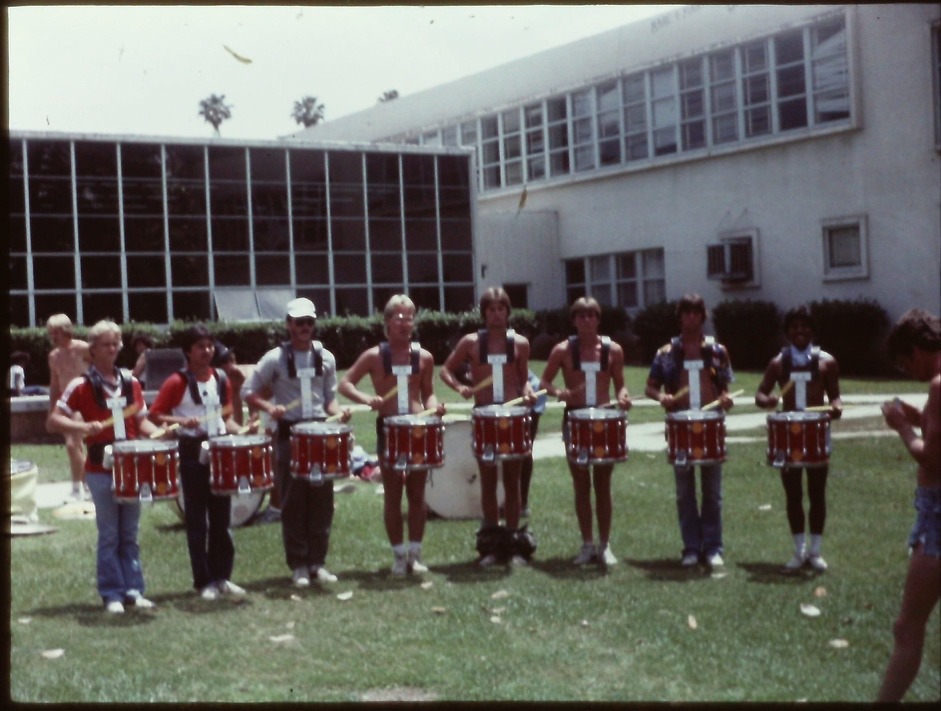
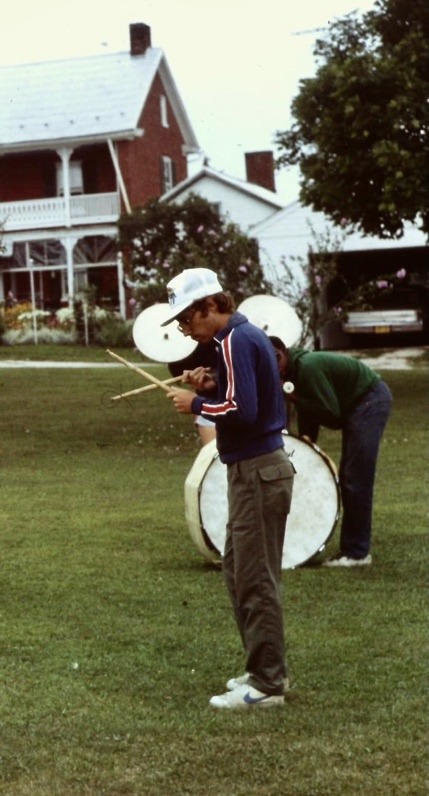
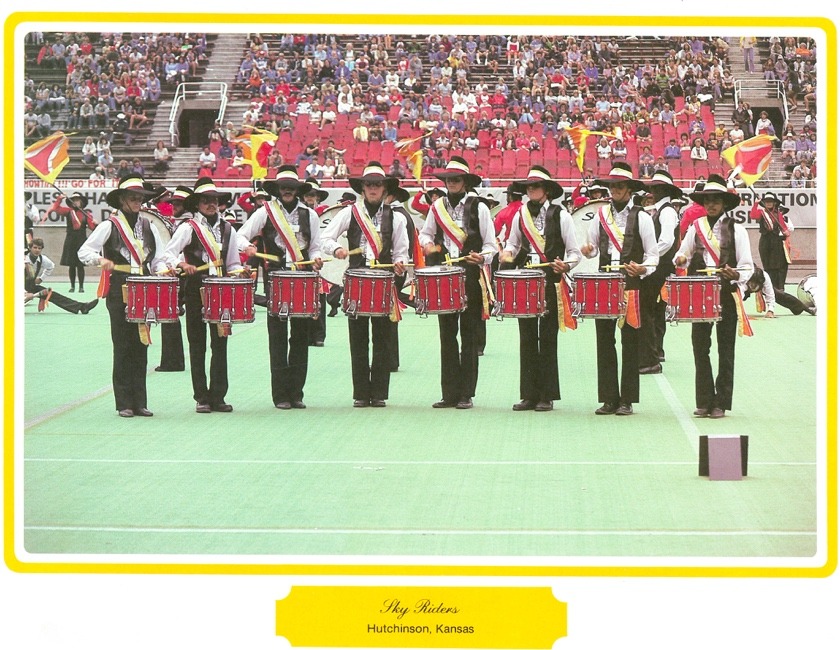
Sky Ryders snare line warming up and looking good already, 1982.
But at the end of the 1983 campaign, the handwriting was on the wall for me when I was told that the board (or someone) wanted Ralph Hardimon (then the caption head for Santa Clara Vanguard and my good friend) to write the drum book for the 1984 season. But as a young hothead, I told them that I didn’t want to clean someone else’s drum parts and I effectively retired myself from drum corps (well almost). I didn’t see another drum corps show until 1993.
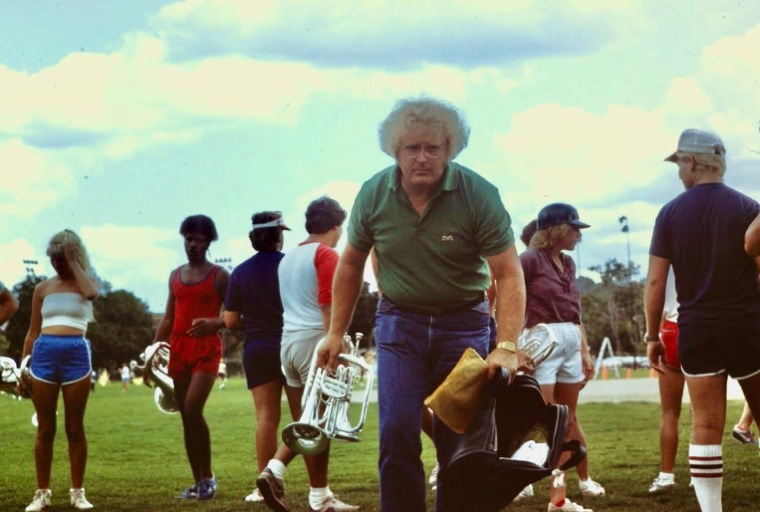
Legendary horn instructor and DCI Hall of Fame Member, John Simpson in his element (1942-2025).
At the time I didn’t know that the Sky Ryders had also let go the luminary corps director George Tuthill (World Drum Corps Hall of Fame member who orchestrated our rise to the Top-12) and John Simpson (legendary horn instructor and DCI Hall of Fame Member).
The next season, the corps finished in 17th place, exactly where they were in 1980; the year before I came to Hutchinson. I guess you have to prune something back before it can grow again because the Sky Ryders would come back stronger several years later with three more appearances in the Top-12, including their highest ranking of 9th place in 1986. In 1991 the corps placed 10th after relocating to DeSoto, Tx, but unfortunately that success didn’t last and the corps finally folded in 1994.
The current Sky Ryders website states that “twenty-nine years later, Sky Ryder alumni led by Dr. Jay Smith founded the Sky Ryders Performing Arts Foundation (SRPAF) in Hutchinson, with the intention of bringing the Sky Ryders back to the community where it began over seventy years ago.” I was happy to see the corps getting back on the field in Kansas and enjoyed the opportunity, at the 2026 Kansas Day of Percussion, to see and hear part of the drumline prior to their move-in day a few months later. They were excited to continue working their way (once again) up the ladder of DCI. “It was ever thus,” I thought to myself as I wished them the best of luck for the coming season!
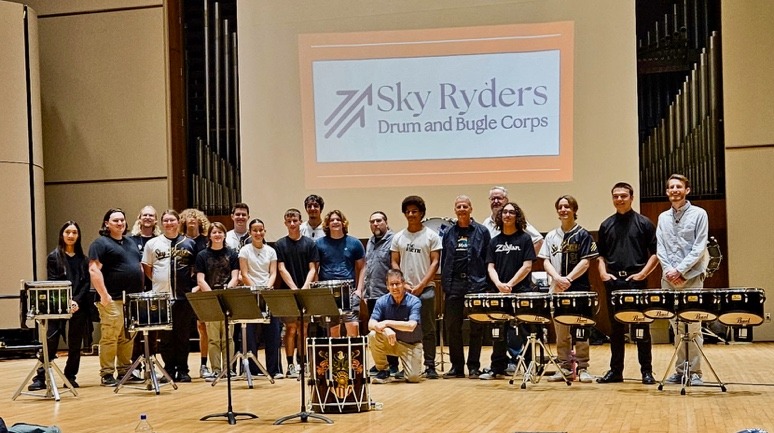
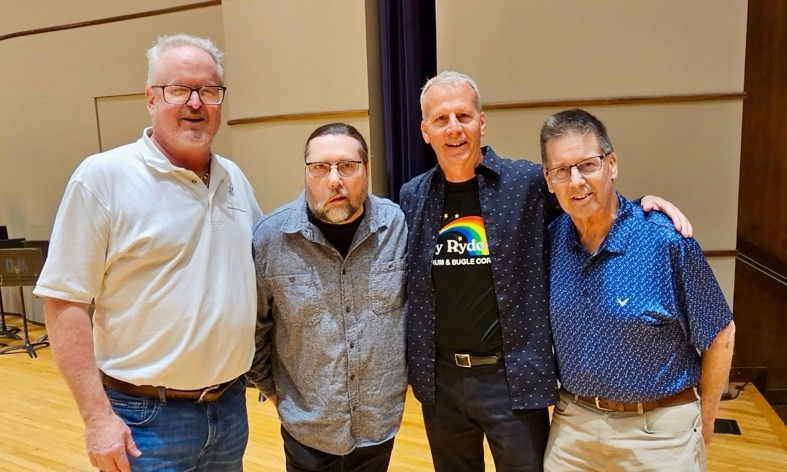
Sky Ryders drumline and staff with alumnus Russ Chandler and percussion coordinator Eric Sheffler.
I was also pleased to learn that there are many people from my era involved in the revival of the Sky Ryders including, among others, Mary Searcy-Price, Russ Chandler, Craig Coldren, and Eric Sheffler (a bit before my time in Hutch).
Kansas Day of Percussion 2026 with Mat Britain, Eric Sheffler, and Russ Chandler.
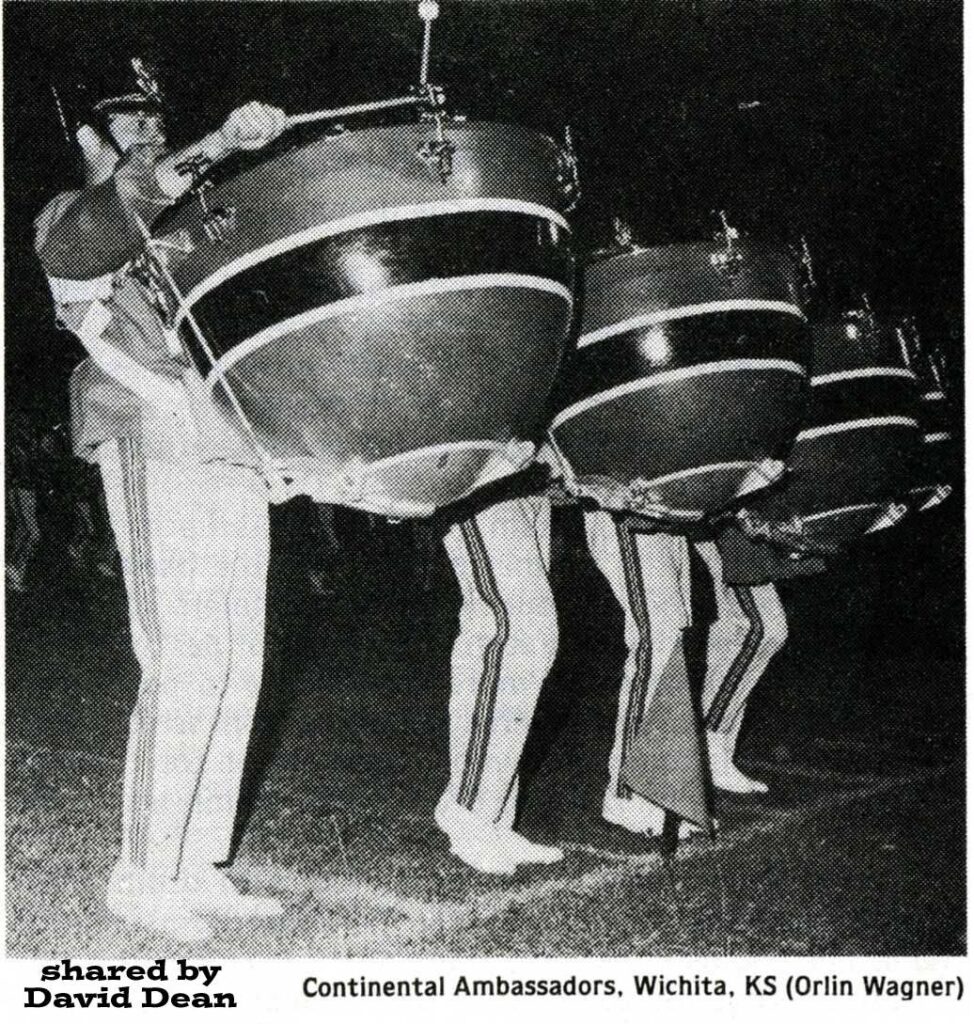
Before their move to Texas, the Sky Ryders were perhaps the only remaining drum and bugle corps in Kansas. Once upon a time Kansas corps included the Argonne Rebels, Salina Silver Sabres, and the Frontiersmen and Trailblazers of Overland Park. In Wichita there were the Plainsmen, Phantom, the Scarlet Lancers, and the Continental Ambassadors. Phantom and the Scarlet Lancers later joined forces with the Continental Ambassadors to form an active and successful corps in the 1970s.
Nothing better than a marching timpani section, but the Continental Ambassadors had a good one back in the day
I say that I “almost” retired from drum corps because in 1984 I served a brief stint as director of the Continental Ambassadors while the corps was trying to reform again. We had a good off season with about 30 kids until we learned that the parents of two corps members were embezzling money from the bingo game. The corps declared bankruptcy then folded once and for all. My retirement from drum corps was complete.
A few years ago, I was asked to sit for an interview with Sky Ryder alumnus Rich Garcia to talk about the 1982 Sky Ryders for a virtual tour. One of the questions he planned to ask was about my proudest moments from the 1982 season. That was going to be a challenge because there were so many accomplishments that had already been talked about during the course of the virtual tour.
It was fascinating to follow the virtual tour and read the recollections of those who shared our journey. I didn’t want to recount anything that had already been discussed—hardships, turning points, moral victories, literal victories—so it was going to be difficult to find something new to say. Or so I thought. I was proud of all our many accomplishments. The Sky Ryders were innovators in body movement, storytelling, acrobatics, development of the front ensemble, percussion ensemble influenced drum solos and many other advancements that are common today. The rifle line alone redefined what it meant to “twirl” a rifle. But there was one more thing.
Clicking sticks in 1982, Any Town, USA.
As the interview was nearing the 2-hour mark, I remember thinking that we hadn’t actually gotten to the question of my proudest moments in direct terms. But there was something that I was especially proud of. It had been in the back of my mind for a long time, hadn’t been talked about, and needed to be said.
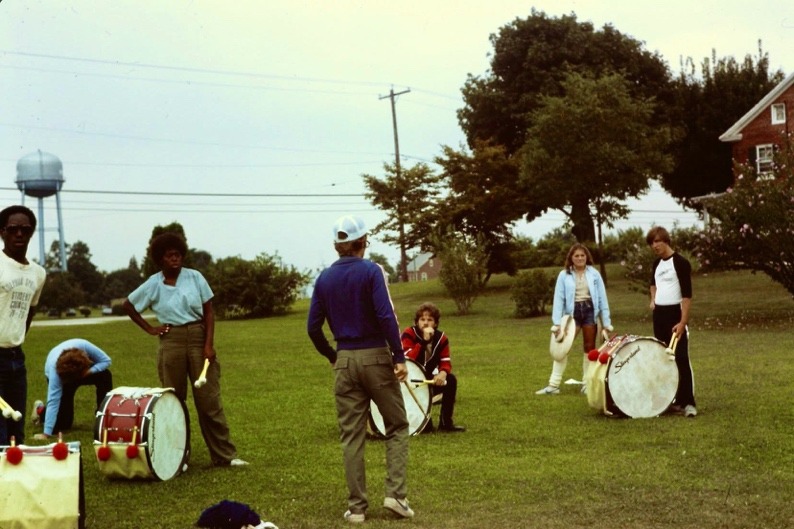
When I think about what was most meaningful to me during my time with the Sky Ryders, what I remember most, is that when I looked at the group of people who comprised that corps, I saw black faces, white faces, and brown faces. There were young men and women ages 14 to 21 who lived, worked, and travelled in (very) close proximity for more than three months. They endured hardships and adversity, faced down their fears* and insecurities, and made their presence known to the drum corps world.
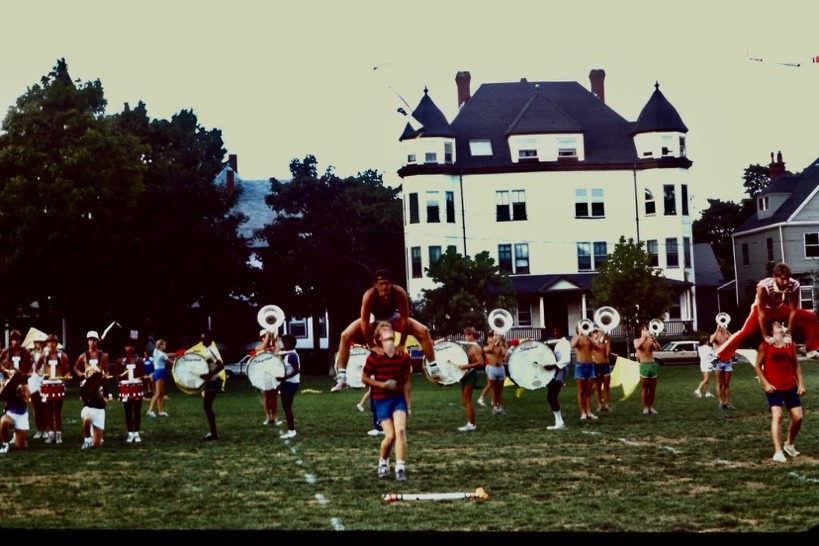
*Perhaps a fear to overcome would be trying to catch a spinning three-pound wooden rifle thrown 20-feet into the air while looking into the sun as another person is leap-frogging over your shoulders; for example.
Today, there are so many things in this world that are used to divide people. Race, religion, age, gender, and sexual preference are all weaponized to keep us apart and distrustful of one another. But to the Sky Ryders, none of those things mattered. One of the corps members from 1982 told me that “I don’t remember race, diversity, or inclusion being addressed, talked about, or even an issue with the Sky Ryders, but that’s from my perspective as a white person. I think we were just so focused on the task at hand and pulling together as a team. What mattered most was working together and looking out for each other.”
Yet people of different races experience things differently. We all have unique vantage points to observe history. For example, I didn’t immediately recall the circumstances of our midnight departure from a certain town due to the actions of a few drunken cowards shouting racial slurs from the shadows outside our host school. I asked one member of color if he remembered the incident, but he didn’t. He had joined the corps only a few days earlier and was probably already passed out from exhaustion. But another person remembered the incident quite clearly. She recalled that it was a “frightening situation.”
But that night George let the local constabulary know that he was not happy about the welcome we were receiving from their “friendly” town before saying “we’re leaving.” And away we went—complete with a complimentary police escort. At that point in the season, everyone was so conditioned to just start moving whenever corps manager Mr. Bill said, “pack it up, we’re leaving in 30-minutes.” I’m sure most people were unaware of why we were departing so suddenly, but George, a native New Yorker, just couldn’t stand being there any longer because “where some of us weren’t welcome, none of us were welcome.” It became a galvanizing moment in our story that only strengthened our bond.
The Sky Ryders never judged each other by the color of their skin but by the content of their character (I’ve heard that phrase somewhere before). Possessing the ability to accept instruction and show measurable improvement in a reasonable amount of time was the only criteria to be a Sky Ryder. If those characteristics were embodied within a good soul, we could help them develop the skills necessary to “imagine our desired outcome” (as the Inner Game of Tennis would teach us).
Clearly having a philosophical discussion with the bass and cymbal line about something important, 1982
Well-meaning people say, “I don’t see race; I don’t see color.” But that isn’t really true, is it? Everyone sees difference. The real distinction is how you react to those differences and how you treat people. Yes—the content of your character! The Sky Ryders’ reaction to difference was always “So What? Let’s go practice.”
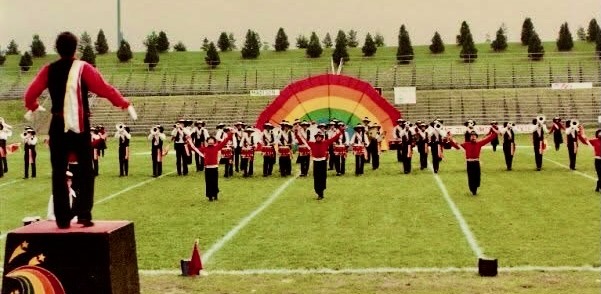
Back in the day the Sky Ryders were known as the Rainbow Corps even before rainbows were a thing. Most people thought it was because of the whole “Wizard of OZ, Somewhere Over the Rainbow” vibe from a proud Kansas drum corps. Maybe so, but it means so much more. Not as some political statement but as a manifestation of the true American ideal in action.
So, in a few days DCI finals will be over and another winner will be crowned. The memories from the best worst summer(s) of your life will fade into the background once again. It’s just good to know that the friendships and memories of a summer long past and the group of people you shared it with will stand the test of time in your memories. Whenever you hear that “certain song,” or maybe once a year on March Fourth, or during Finals Week, those memories will come rushing back. You’ll smile, maybe wipe away a tear, and remember…
“I have a dream that my four little children will one day live in a nation where they will not be judged by the color of their skin but by the content of their character.” —Dr. Martin Luther King Jr.