In what has become a Groundhog Day tradition, every February 2nd I write a blog about one of my all-time favorite films, Groundhog Day, which stars Bill Murray and Andie McDowell and was (re)written and directed by Harold Ramos. In my opinion, it is one of the most imaginative films of all time, yet it received rather lukewarm reviews at the time of its release in 1993. That it has become a cult classic is a testament to the film’s staying power.
Adding to that legacy, and according to Wikipedia, “the phrase ‘Groundhog Day’ has become a common term to reference a repetitive, unpleasant, and monotonous situation. It is recognized by dictionaries under two definitions: the holiday itself, and ‘a situation in which events are or appear to be continually repeated.’”
That said, last year I ditched Groundhog Day in favor of a post about creativity. I made this decision because of a “moment of clarity” (i.e. Realizing that no one cares about Groundhog Day as much as I do). So, I decided instead to talk about “moments of clarity” in the creative process. That was Part I. In the post I also said, “stay tuned for Part II, the next time I get a moment of clarity (practically assuring that it would never happen).” Well, here we are again—February 2nd—Groundhog Day—and Bing!—Clarity.
Part II.
Possibly one of the worst things that has happened to me as a maker of music and art was to be called “creative.” A friend once introduced me as “the most creative person I know.” After that generous and thoughtful introduction, I couldn’t come up with an original thought for months. The pressure to keep being something I never thought I was in the first place was too much of a burden.
The simple fact is that I don’t consider myself to be a particularly creative person. I do work every day at letting ideas come into my head by keeping a playful, childlike attitude of discovery, and by surrounding myself with people who have the ability to say completely silly and delightfully non-sequitur things until an idea takes hold and “discovers itself.” It really works! Try it!
I have a group of friends and colleagues who all bring out the best in each other and me. If I am struggling to come up with an idea for a project, all I need to do is get on the phone with one or two key people, talk for a while, listen a lot, make some dumb jokes, and “Bob’s your uncle,” I’m a genius! *
*NOTE: I don’t really think I’m a genius.
It takes serious effort to have an original thought, but unfortunately, having the thought isn’t the end of the process of creation! It’s just the beginning. Renowned Broadway composer and lyricist, Stephen Sondheim (1930–2021) describes the creative process like this:
“Bit by bit, putting it together…
Piece by piece, only way to make a work of art.
Every moment makes a contribution,
Every little detail plays a part.
Having just the vision’s no solution,
Everything depends on execution,
Putting it together, that’s what counts.”
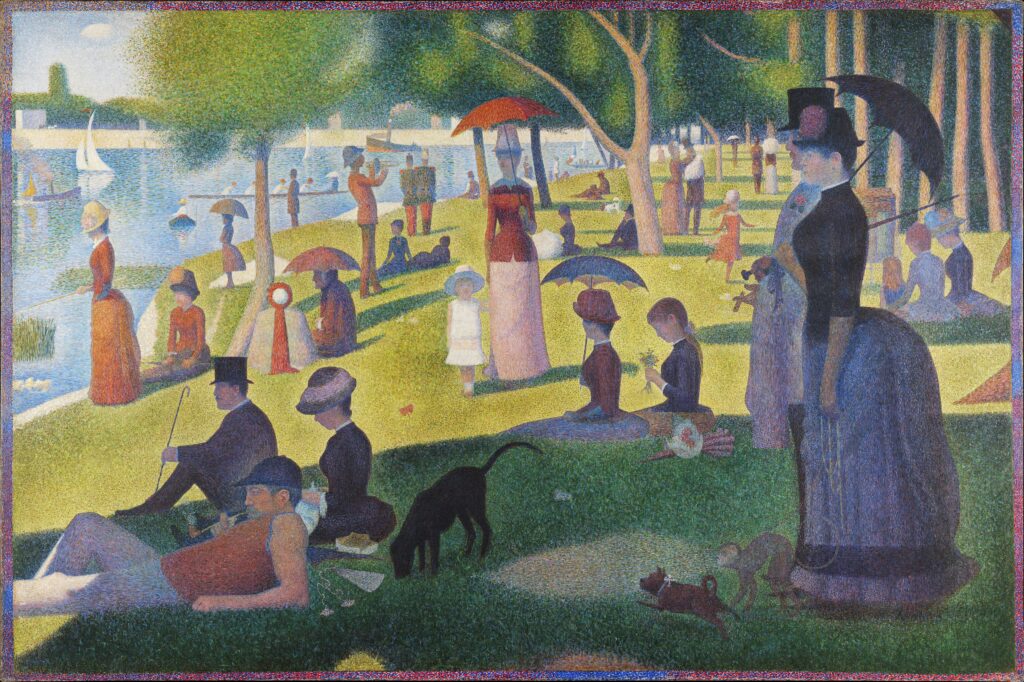
These are lyrics from the song Putting it Together from Sondheim’s Broadway play Sunday in the Park with George. The story is about the French painter George Seurat who developed the Neo-Impressionist painting style known today as pointillism, but it is also an excellent commentary on the creative process.
Prominent art historian, curator, and author, Dita Amory writes that “Neo-Impressionism is a term applied to an avant-garde art movement that flourished principally in France from 1886 to 1906. Led by the example of Georges Seurat, artists of the Neo-Impressionist circle renounced the random spontaneity of Impressionism in favor of a measured painting technique grounded in science and the study of optics.”
She goes on to say that “in the words of the artist Paul Signac, Neo-Impressionism’s greatest propagandist, ‘the separated elements will be reconstituted into brilliantly colored lights.’ The separation of color through individual strokes of pigment came to be known as Divisionism, while the application of precise dots of paint came to be called Pointillism.’”
Sondheim continues:
“Ounce by ounce, putting it together…
Small amounts, adding up to make a work of art.
First of all, you need a good foundation,
otherwise it’s risky from the start.”
That’s right, mastering an art takes real work, the kind of thoughtful effort that is built up over time and supported by mastery of the fundamentals of your craft. Progress can often seem illusive and slow, or it may not happen at all. That is a risk you have to take, but this is where the idea of putting something together piece by piece, dot by dot, bit by bit, ounce by ounce, or note by note, comes into focus. It is progress that takes place in increments—typically measured in inches rather than miles.
In music, the methods for improvement of musical techniques are simple to understand however acting on them is—for some—a challenge. Any creative pursuit takes personal discipline to unlock the potential of a great idea.
“Having just a vision’s no solution,
Everything depends on execution.”
The art of making art
Is putting it together
Bit by bit…
Legendary drummer Billy Cobham once said that “there are gifts, but sometimes the gift is an idea.” It’s one thing to have an idea but do you have the time, energy, discipline, or skills to act on that idea?
The writer Somerset Maugham didn’t believe that ideas were gifts to be bestowed upon us by a Muse. His most famous quote on writing emphasizes discipline over waiting for inspiration: “I write only when inspiration strikes. Fortunately, it strikes every morning at nine o’clock sharp.”
Now, let’s say you have a great idea, and for once all the stars align so that you have the time, energy, opportunity, facility, and funding to realize it. Awesome! But then, as if a dagger to the heart, Sondheim adds a warning that even if you make it this far in the creative process, it can still fail:
Art isn’t easy.
Even if you’re smart.
You think it’s all put together,
But then something falls apart
Sometimes making art can feel a bit like Groundhog Day I suppose, but with perseverance and discipline you can tap into your imagination which is where the best ideas are born and where they hide from most people. At the end of the day, it is important to hold on to your goals, your vision, and your imagination because while nobody can predict you WILL be successful in your chosen field of endeavor, neither can they say you WON’T. As the great comedian and actor Jonathan Winters (1925-2013) once said, “I couldn’t wait for success, so I went ahead without it.” You should too.
My advice is to hold onto your childlike imagination because that opens the door to moments of clarity and, dare I say, creativity. Just don’t let anyone try to tell you that you are creative, and if they do, don’t believe it!
Citations:
Amory, Dita. Georges Seurat (1859–1891) and Neo-Impressionism, The Met, October 1, 2004
https://www.metmuseum.org/toah/hd/seni/hd_seni.htm
Streisand, Barbra. Putting it Together, The Broadway Album, A&M (Hollywood),1985
Sondheim, Stephen; Lapine, James. Sunday in the Park with George, 1983